Sunday, June 15, 2014

"What is the Worth of Fathers?"

Happy Father's Day to all you fathers out there. For this year's Father's Day, I am reprinting something I had written back in February 2012.

* * * * *
One of the most insidious results of the welfare state and the feminist movement is the loss of respect for fathers, or even the belief that fathers are needed in a home. We are surrounded with ads and TV shows that show fathers as clueless idiots--essentially just another child for the mother to care for and look after. The legal system bases custody on "the best interests of the children" which has merely become a code phrase for "fathers not needed." Even my church, sad to say, while emphasizing the importance of motherhood, significantly downplays the importance of fathers.

I was reminded of the importance of fathers today when reading this article concerning on how New Jersey's court system has usurped the powers and authority of the legislature in important areas, including education. It noted:
The court also seemed oblivious to the fact that, no matter how much money the state spent, educational “adequacy” in the Abbott districts would remain a casualty of widespread family breakdown. In Newark and Camden, about 70 percent of children grow up in homes without fathers—which, research shows, frequently leads to dismal academic performance and high drop-out rates. “While many of the mothers and grandmothers were making a tremendous effort with their children, the consequences for most of the fatherless kids were devastating,” wrote Saul Cooperman, the state’s former education commissioner, in a 2002 op-ed. Assessing the likely effectiveness of the supreme court’s education mandates, Cooperman was blunt: “Until dramatically more fathers as well as mothers raise their children in our cities, we may be disappointed with the results.”
Why are fathers so important? It is because fathers inculcate skills and discipline in their children that mothers, single or not, don't.

As noted sociologist David Popenoe explains,
Fathers are far more than just ‘second adults’ in the home. Involved fathers – especially biological fathers – bring positive benefits to their children that no other person is as likely to bring.
Fathers bring good, essential things to the lives of children. Children are impoverished developmentally when they are deprived of their father’s love.
The Review of General Psychology concludes:
Many studies conclude that children with highly involved fathers, in relation to children with less involved fathers, tend to be more cognitively and socially competent, less inclined toward gender stereotyping, more empathetic, and psychologically better adjusted.
(Footnotes omitted). (See also this article). And, from the U.S. Department of Health and Human Services:
Even from birth, children who have an involved father are more likely to be emotionally secure, be confident to explore their surroundings, and, as they grow older, have better social connections with peers. These children also are less likely to get in trouble at home, school, or in the neighborhood. Infants who receive high levels of affection from their fathers (e.g., babies whose fathers respond quickly to their cries and who play together) are more securely attached; that is, they can explore their environment comfortably when a parent is nearby and can readily accept comfort from their parent after a brief separation. A number of studies suggest they also are more sociable and popular with other children throughout early childhood.

The way fathers play with their children also has an important impact on a child's emotional and social development. Fathers spend a much higher percentage of their one-on-one interaction with infants and preschoolers in stimulating, playful activity than do mothers. From these interactions, children learn how to regulate their feelings and behavior. Rough-housing with dad, for example, can teach children how to deal with aggressive impulses and physical contact without losing control of their emotions. Generally speaking, fathers also tend to promote independence and an orientation to the outside world. Fathers often push achievement while mothers stress nurturing, both of which are important to healthy development. As a result, children who grow up with involved fathers are more comfortable exploring the world around them and more likely to exhibit self-control and pro-social behavior.

One study of school-aged children found that children with good relationships with their fathers were less likely to experience depression, to exhibit disruptive behavior, or to lie and were more likely to exhibit pro-social behavior. This same study found that boys with involved fathers had fewer school behavior problems and that girls had stronger self-esteem. In addition, numerous studies have found that children who live with their fathers are more likely to have good physical and emotional health, to achieve academically, and to avoid drugs, violence, and delinquent behavior.

In short, fathers have a powerful and positive impact upon the development and health of children. A caseworker who understands the important contributions fathers make to their children's development and how to effectively involve fathers in the case planning process will find additional and valuable allies in the mission to create a permanent and safe environment for children.
(Footnotes omitted).

Friday, June 13, 2014

The Breakup of Iraq

After the fall of the Ottoman Empire, the Europeans split up the Middle-East according to their whims rather than based on ethnic, religious, or geographic realities. So now we are watching the collapse of one of these artificial entities. 

The Independent reports:
Iraq is breaking up. The Kurds have taken the northern oil city of Kirkuk that they have long claimed as their capital. Sunni fundamentalist fighters vow to capture Baghdad and the Shia holy cities further south.

Government rule over the Sunni Arab heartlands of north and central Iraq is evaporating as its 900,000-strong army disintegrates. Government aircraft have fired missiles at insurgent targets in Mosul, captured by Isis on Monday, but the Iraqi army has otherwise shown no sign of launching a counter-attack.

The nine-year Shia dominance over Iraq, established after the US, Britain and other allies overthrew Saddam Hussein, may be coming to an end. The Shia may continue to hold the capital and the Shia-majority provinces further south, but they will have great difficulty in re-establishing their authority over Sunni provinces from which their army has fled.
 It is unlikely that the Kurds will give up Kirkuk. “The whole of Kirkuk has fallen into the hands of peshmerga [Kurdish soldiers],” said the peshmerga spokesman Jabbar Yawar. “No Iraqi army remains in Kirkuk.”
 The article goes on to describe the basic conflict in terms of Shiite versus Sunni.

The Daily Mail makes similar observations, devoting an entire article on the Shiite and Sunni conflicts and tensions throughout the Middle-East. It observes:
Its [ISIS'] extraordinary success could not have been achieved without the tacit support of ordinary Sunni people in the areas it has conquered.

The Sunnis in Mosul regarded the Shia-dominated army from the south of the country as an occupying force and were only too pleased to see the back of them.
 
True, these people are terrified of the brutal ideology of ISIS, which specialises in amputations and crucifixions for those who do not subscribe to its fundamentalist creed.

But for now, their hatred of al-Maliki’s authoritarian government, which treats them as a lower caste, outweighs those fears.
It goes on to mention:
Meanwhile, across the Middle East, Sunni and Shia rivalries are festering like open sores. Of the world’s 1.6billion Muslims, the vast majority are Sunnis; Shias comprise 10 to 15 per cent - two hundred million people.  
Egypt, Turkey, Bahrain and Saudi Arabia are Sunni. In Bahrain and Saudi Arabia, the ruling Sunni treat Shia as second-class citizens.  
The Shia are concentrated in Iran, southern Iraq and Lebanon. And despite being in the minority in Syria, they are powerful there, too: President Bashar Assad’s ruling party belong to a Shia sect called the Alawites. 
Once you understand the Sunni/Shia divide, you can make sense of the rivalries in the Middle East. It explains why Sunni rebels - backed by the predominantly Sunni powers, ranging from Turkey to Saudi Arabia and the smaller Gulf states - are determined to fight Assad’s Shia-dominated army to the death. 
And why Lebanese Hizbollah militias (Shia) are fighting for Assad, under the command of Revolutionary Guards officers from Iran (also Shia).
 ISIS, true to their nature, is already initiating a bloody reign of terror. The Daily Mail reports:
The full horror of the jihadists’ savage victories in Iraq emerged yesterday as witnesses told of streets lined with decapitated soldiers and policemen. 
Blood-soaked bodies and blazing vehicles were left in the wake of the Al Qaeda-inspired ISIS fanatics as they pushed the frontline towards Baghdad. 
They boasted about their triumphs in a propaganda video depicting appalling scenes including a businessman being dragged from his car and executed at the roadside with a pistol to the back of his head.
... In the swathe of captured territory across northern Iraq, ISIS declared hardline Sharia law, publishing rules ordering women not to go outside ‘unless strictly necessary’, banning alcohol and smoking, and forcing all residents to attend mosques five times a day. BBC correspondent Paul Wood said one woman from Mosul, Iraq’s second city, had spoken of seeing a ‘row of decapitated soldiers and policemen’. 
The refugee woman told how the victims’ heads were placed in rows – a trademark, trophy-style execution favoured by ISIS militants.
Michael Totten writes:
Al Qaeda splinter group ISIS has taken the Iraqi city of Tikrit and the Kurdish Peshmerga has taken the Iraqi city of Kirkuk. Iraq's army fled both and hardly fired a shot. 
God only knows what happens next, but this much is clear—the Syrian war is no longer the Syrian war. It’s a regional war. It spilled into Lebanon at a low level some time ago. It sucked in Iran and Hezbollah some time ago. Now it is spreading with full force at blitzkrieg speed into Iraq and has even drawn in the Kurdistan Regional Government which managed to sit out the entire Iraq war. 
This could easily suck in Turkey, Jordan, and Israel before it’s over. 
... Arab governments complain when we intervene and they complain when we don't intervene. Basically, they complain no matter what. So asking what they want is pointless. It takes a while to notice this trend over time, but there it is. They have not stopped to consider the consequences of this behavior, but those consequences are about to become apocalyptic for Nouri al-Maliki. 
“We’ll kill you if you mess with us, but otherwise go die” is not even close to my preferred foreign policy, but it’s what President Barack Obama prefers (phrased much more nicely, of course) and it’s what the overwhelming majority of Americans prefer, including most liberals as well as conservatives. 
Still, it’s only a matter of time before we get sucked in kicking and screaming one way or another. Because the Middle East isn’t Las Vegas. What happens there doesn’t stay there.
A state of peace is the direct result of civilization. Arab civilization (if there was any such condition) died a long time ago. ISIS represents the barbarians of the Middle-East.

Thursday, June 12, 2014

Comparing Apples and Oranges

File:Apple and Orange - they do not compare.jpg
(Source)

Although I have my opinions of certain teachings, tactics, and rules-of-thumb found among the various survival and prepping blogs and websites, I generally try to avoid criticizing other preppers and survivalists. My article on the 5 top firearm myths for survivalists is the most I've ever done to criticize the ideas of others, and that is because I'd become fed up with what I thought was bad advice that seemed to be widely dispensed or spread through the prepping community.

That said, there is the occasional article or post that you have to wonder what they were thinking. Survival Life recently published an article comparing the AK47 with the Ruger 10/22 as to which is the better survival rifle. There are some technical errors in the article which are discussed in the comments to the article. What surprised me is that someone would even compare the two weapons, since they are intended for such different uses.

The article begins as a nice positive review of the Ruger 10/22, giving the impression, notwithstanding the title, that it was simply reviewing the two rifles. But then the author adds this final paragraph:
The Ruger has a ten round magazine, although sometimes people do not have the money to buy a larger one, it is a good idea. Without one it could leave them in a bad situation when faced with many attackers. Having an extra magazine on hand is a good idea because having to reload after firing ten shots with oncoming enemies could be a fatal mistake.
The author then reviews the AK-47/AKM--not the semi-auto AK clones and rebuilds, but the select fire version. He writes:
The operating cycle is pretty straightforward. Since the gun has a thirty round magazine, it makes it a good weapon to use against a small number of intruders. First, you must pull back the charging handle after inserting the magazine and pull the trigger to fire. Semi-automatic is a good setting if you are facing one attacker where you must let the trigger be released and pulled again for the next shot. When faced with multiple attackers, full automatic is preferred. The trigger can be held to fire until the magazine is dry or the gunman releases the trigger.
Then, to make sure that you understand that the article was comparing the two as to their merits as combat or defensive weapons he writes:
No matter what we have to say about these survival rifles, you have to think about yourself and your family, and if they are willing to shoot it if the need arises. You have to think about costs and ammunition, magazine capacities, and other elements of a rifle to make it substantial to your needs. But out of all the numerous choices, we suggest one of the above two for your budget and survival necessities.
Without getting into why its ineffective to use an assault rifle as a bullet hose, or the cost and bureaucratic hassle of obtaining a select fire weapon, the very idea of comparing the two rifles for purposes of combat is ridiculous.

A .22 LR may be acceptable for self-defense compared to other handgun rounds because, overall, handgun rounds are generally underpowered. The increased accuracy and speed to return to target from a larger .22 pistol (e.g., a Ruger Mark III or Browning Buckmark) may compensate for the lack of power and penetration compared to a 9mm or .45ACP, for instance. But for a defensive rifle, the differences are too extreme.

A .22 LR rifle is intended for target practice and hunting small game. In a pinch it can be used for larger game, but it will not reliably kill larger game animals. (Yes, I know you can put down a cow with a .22, but most game animals won't calmly let you walk up and put a gun barrel to their forehead). But it is not a combat round. It lacks the penetration and power to reliably get through even flimsy barriers at moderate ranges, and, absent a killing shot, lacks the power to disable an attacker.

Look at it this way. Given the relative cost and weight between .22 LR and military rifle rounds, if .22 LR was in any conceivable way an effective combat round, every military in the world would be using it. However, even the most cost conscious governments don't.

The 7.62x39, on the other hand, is acceptable for taking medium sized game, and proven itself in combat. Poachers use it to kill elephants and rhinos, so apparently, in large enough doses, it can even be used to kill the largest animals. But even if you could hit a rabbit or possum using an AK, it won't leave much usable meat behind. It is not a small game hunting round.

And that is the difference between the rifles. One is suitable for small game; one is suitable for self-defense and medium game. They are complimentary, but one is not a replacement for the other.

That said, this is not the only instance I've seen people recommend a .22 rifle for self-defense. Recently, for instance, I saw a survival magazine at the local grocery store featuring Ruger's take-down 10/22 rifle on the cover, and proclaiming it as the best survival and defensive rifle ever. I have no problem with someone proclaiming a particular .22 rifle as a good (or best) survival rifle because "survival" means different things to different people--some people think lost in the wilderness, some think following an earthquake or flood to fend off feral dogs, and some think Mad Max. But combat or self-defense is more specific, and it is a disservice to suggest that the .22 LR is an effective combat rifle round.

Update on ISIS/Iraqi Conflict

Obama has no problems using drones in Yemen and Afghanistan, but he wants Iraq to remain Bush's fault. According to the New York Times:
As the threat from Sunni militants in western Iraq escalated last month, Prime Minister Nuri Kamal al-Maliki secretly asked the Obama administration to consider carrying out airstrikes against extremist staging areas, according to Iraqi and American officials. 
But Iraq’s appeals for a military response have so far been rebuffed by the White House, which has been reluctant to open a new chapter in a conflict that President Obama has insisted was over when the United States withdrew the last of its forces from Iraq in 2011. 
The swift capture of Mosul by militants aligned with the Islamic State of Iraq and Syria has underscored how the conflicts in Syria and Iraq have converged into one widening regional insurgency with fighters coursing back and forth through the porous border between the two countries. But it has also called attention to the limits the White House has imposed on the use of American power in an increasingly violent and volatile region.
Meanwhile ISIS pushes toward Baghdad.  The London Times reports that Iran has sent special forces troops to Iraq to assist the Iraqis:
Iran has sent special forces and a unit of elite troops to Iraq to bolster floundering efforts by the Iraqi government to halt the advance of militants from an al-Qaeda splinter group. 
A 150-man unit of the Quds Force, the elite section of Iran’s Revolutionary Guard, has deployed to Iraq, supported by a team of Saberin, Tehran’s equivalent of the SAS. 
To my unpracticed eyes, it appears that the Administration's goals are two-fold: (1) destroy any semblance of influence that the U.S. has in the region, and (2) support Sunnis in their war against Shiites. (Obama was likely raised as a Sunni, since most Muslims in Southeast Asia are Sunni).

However, there is a broader theme here, as well. In Tainter's work on the collapse of complex societies, he concluded that the interconnection between societies made it impossible for a complex society to collapse, because other nations would step in to fill the vacuum and prop it up. We have seen this in many cases, on of the most recent being the financial support Egypt is receiving from other Arab countries to prevent its total collapse.

But Tainter also indicated that in order for modern society to collapse, it would have to all collapse. I don't know if Tainter believed that it would all suddenly collapse (a house of cards) or that once one society collapsed, collapse would spread to other societies and be neigh unstoppable (dominoes). What we have seen in many situations on the periphery of modern civilization, such as Africa and Central Asia, are smaller societies collapsing into "failed states." But, rather than effectively intervening, the great nations are simply walling these societies off--largely isolating them from the outside world--because they lack the political will and physical/financial means to intervene. It is too early to predict whether Syria and Iraq will join the failed states category. But we may be seeing the first dominoes falling.

Wednesday, June 11, 2014

Dog Meat

Survival UK has some recipes for cooking dog meat.

ISIS Wins Big in Iraq

composite.jpg
Source: Daily Mail

The disastrous loss of Mosul and Tikrit just gets worse and worse.  The Daily Mail has a lengthy and detailed piece worth reading. Among other things, it notes:
While the West has so far refused to assist with military support, the US has said it will come to the aid of the 500,000 people who have fled fierce fighting in Iraq. 
Denouncing ISIS as ‘one of the most dangerous terrorist groups in the world, Stuart Jones, the nominee to be the next US envoy to Baghdad, told US politicians the United States ‘will continue to monitor the situation closely, and will work with our international partners to try to meet the needs of those who have been displaced’.  
Today UK Foreign Secretary William Hague played down any suggestion of sending troops to support the Iraqi military and the White House National Security Council said: 'President Obama promised to responsibly end the war in Iraq and he did'. 
A country into which America poured so much blood and money faces the prospect of dealing with this major new military threat by itself in light of Western governments' insistence that the matter is not their concern.
Also, the terrorists have seized weapons. From the story:

Insurgents and Iraqi troops have been fighting for days in Mosul, but the security forces' hold appeared to collapse late Monday night and early Tuesday.  
Gunmen overran the Ninevah provincial government building - a key symbol of state control - Monday evening, and the governor fled the city.  
The fighters stormed police stations, bases and prisons, capturing weapons and freeing inmates. Security forces melted away, abandoning many of their posts, and militants seized large caches of weapons.  
They took control of the city's airport and captured helicopters, as well as an airbase 60 kilometers (40 miles) south of the city, the parliament speaker said.
The story indicates that the Kurds may send troops beyond the borders of their autonomous region to deal with insurgents, which in itself may cause additional problems as some of the areas occupied by the militants have large Kurdish populations which the Kurds want to include in their zone.

The Telegraph is reporting mass beheadings in Mosul and Tikrit. The International Business Times reports:
The Islamic State of Iraq and al-Shams (Isis) has become the richest terror group ever after looting 500 billion Iraqi dinars - the equivalent of $429m (£256m) - from Mosul's central bank, according to the regional governor. 
Nineveh governor Atheel al-Nujaifi confirmed Kurdish televison reports that Isis militants had stolen millions from numerous banks across Mosul. A large quantity of gold bullion is also believed to have been stolen.
The Turkish consulate in Mosul was seized, and Turkish truck drivers have been captured, which has prompted Turkey to call for an emergency meeting of NATO.

ISIS Captures Tikrit

As an update to yesterday's post about the threat of ISIS, this from the VOA News:
Iraqi security officials say Islamist militants who took over the city of Mosul Tuesday have seized the city of Tikrit, less than 200 kilometers (124 miles) from Baghdad. 
The officials said the Sunni militants have moved southward from Mosul, taking control of Iraq's biggest oil refinery and Tikrit, the hometown of fallen Iraqi dictator Saddam Hussein. 
Security officials said the insurgents entered the town of Beiji late Tuesday, set fire to the police station and courthouse, and drove out some 250 men guarding the refinery. The insurgents reportedly offered the guards safe passage if they left peacefully. 
Iraqi state television on Wednesday said the Iraqi Army's 4th brigade expelled the militants from Beiji hours later.

Turkish government sources said militants have seized the Turkish consulate in Mosul, kidnapping 48 people, including the Turkish consul, staff members, guards and three children.
 See here for the BBC report.

Tuesday, June 10, 2014

The Spread of ISIS

Der Spiegel has published an interview with Lakhdar Brahimi, former U.N. special envoy to Syria. In his interview, Brahimi warns that Syria will become a failed state like Somalia, and will be a source of regional instability and violence. From the article:
The opposition is very fragmented, even the Free Syrian Army. But everybody understands that the jihadi group ISIS (Eds. Note: The Islamic State of Iraq and the Levant) is not really interested in Syria. They seek to establish a new order in the region. As long as there are no negotiations, the armed groups as well as the political opposition will continue to be fragmented.
And later:
Brahimi: Unless there is a real, sustained effort to work out a political solution, there is a serious risk that the entire region will blow up. The conflict is not going to stay inside Syria. It will spill over into the region. It's already destabilizing Lebanon, there are 1.5 million refugees in the country; that represents one third of the population. If it were Germany, it would be the equivalent of 20 million. It is destabilizing because ISIS …

SPIEGEL: … the most radical and brutal armed opposition group, which seeks to establish a militant Islamic state …

Brahimi: … is active in both Syria and Iraq already, and Jordan is really struggling to continue resisting. Even Turkey! According to a senior Iraqi official, ISIS has carried out 100 operations in Syria and 1,000 operations in Iraq in just three months.
... Syria is so much worse [than Afghanistan]! This ISIS, they don't believe in just staying there. And they are training people. Your countries are terribly scared that the few Europeans that are there may come back and create all sorts of problems. So just imagine what the feelings are next door!
 Finally:
SPIEGEL: What can the international community do, Europe in particular? What should Germany do?

Brahimi: The people in your governments know how dangerous this crisis is and how important it is to support a political solution.
 
SPIEGEL: Are you referring to the 320 Germans that have thus far joined ISIS?

Brahimi: And to the 500 or 600 French, the 500 or 600 British, and so on and so forth. There are several thousand non-Syrians. My goodness! These are your nationals that are training in Syria and that are part of ISIS, which believes that you have got to build an Islamic state all over the world, starting with Berlin. That's a threat to you, isn't it?
 Read the whole thing. And then consider this news story from today's Long War Journal:
The Islamic State of Iraq and the Sham seized control of Mosul, the provincial capital of Ninewa and Iraq's second largest city, after five days of heavy fighting with Iraqi forces. Mosul is the second major city to fall to the former al Qaeda affiliate.

Fighters from the ISIS took control of government buildings, including the provincial headquarters, as well as police stations and military installations inside and outside of the city, according to reports. Several police stations were torched by the ISIS. Some Iraqi soldiers and policemen are said to have shed their uniforms before fleeing their posts to avoid being captured and executed by ISIS fighters.

The ISIS has raised the black flag of jihad and "announced over loudspeaker that they had 'come to liberate Mosul and would fight only those who attack them,'" the BBC reported.

Usamah al Nujayfi, the speaker of Iraq's Council of Representatives whose brother is the governor of Ninewa, told Al Baghdadiyah Satellite Television that "the right and left sides of the city of Mosul as well as its districts and subdistricts have been completely occupied."

Nujayfi also accused Iraqi security forces of abandoning their posts and leaving weapons, ammunition, and armored vehicles behind.

"When the battle intensified inside the city of Mosul, these forces gave up their weapons and the commanders fled, leaving behind arms, armored vehicles, and locations for the terrorists," Nujayfi continued. "Mosul Airport and some aircrafts and command locations have fallen, not to mention arms warehouses. Prisons have been taken and the prisoners have been released." Some reports indicate that hundreds of prisoners have been freed.
 (H/t Weasel Zippers)

Monday, June 9, 2014

Replacing the Feed Throat on a Marlin "Glenfield" Model 60

Note: This is an expanded and updated version of the earlier article on this topic. However, since I still saw traffic to the original article, but without traffic to the updated article, I have chosen to replace the older article with the new article.


Marlin 60 "Glenfield"


Background

As you can tell from the photograph above, the Marlin Model 60 is a semi-automatic rifle in .22 LR caliber, fed from an underbarrel tube magazine. 

It is one of the most popular, if not the most popular, .22 rifles produced, with approximately 11 million made to date. The rifle has been in continuous production since 1960 in various configurations or variants. Prior to 1980, the rifle boasted a 22-inch micro-groove barrel, and the magazine held 17 rounds. About 1980, the magazine capacity was reduced to 14-rounds. Subsequently, the barrel was shortened to 19 inches to match the shorter magazine. 

The rifle uses a simple blowback system. Although older rifles, such as the one pictured above, did not have a bolt hold-open, I understand that the newer versions do so. The front sight is a simple ramp. The rear site is an open semi-buckhorn style adjustable for elevation. Older models used birchwood stocks and had pressed "checkering" and patterns, including the squirrel hunter shown above. Newer models have plain walnut, laminated, or synthetic stocks, depending on the specific variant.

Mechanically, the rifle has changed very little over its history--with one significant exception. The original rifles used a cast pot-metal (aluminum, probably) "feed throat" through which the bullet was lifted and fed into the chamber. The "feed throat" has the feed ramp and an integral ejector molded into it. In the older models, it was molded in two pieces that fit together length wise, that were held together with a single rivet. Due to reliability and durability issues, this design was later changed to a single cast piece that uses one tail of the lifter spring as the ejector.


The Project

The particular model shown here is an older model, although I don't know the specific date of manufacture. It features the longer barrel and tube magazine, as well as the original feed throat design. When I first obtained the rifle, it was missing the rear sight elevator ramp, which was easily replaced.

I discovered that the rifle also had feeding problems. Although the rifle ejected without trouble, about every other round would misfeed, being pushed up and into the rear of the barrel instead of into the chamber. Initially, I just assumed this was perhaps due to inadequate cleaning. However, after a complete disassembly and cleaning, I still had the same problem. I took the rifle to a gunsmith who, a couple months later, told me the issue was simply one of ammunition. Nevertheless, I still experienced the same feeding problem no matter what type of ammunition I used.

After disassembling the rifle again and paying more attention to how the mechanism worked, I discovered that the screws attaching the action to the receiver had loosened, allowing the feed throat to be forced apart--just enough that it allowed a cartridge to feed at too steep of angle to go into the chamber. After I tightened the screws down, the problem was mostly solved. However, the side plates that hold the action together cannot be tightened down enough to completely eliminate the gap between the pieces of the feed throat.

I decided to replace the feed throat with a newer, one-piece version. Marlin sells a feed throat conversion kit to adapt the older models, although you can also buy the pieces separately. Brownells, Numrich and Midway carry parts--I used Numrich and Midway for the parts for this project. Brownells has an exploded parts diagram that may be useful, even though it is for the newer version of the Model 60.

Warning: The modifications and instructions set out herein were for my firearm, but may not work for yours. All information is presented for entertainment purposes only, and you rely on it at your own risk.

Differences Between the Old and New Feedthroats


The installation of a new feed throat into an older Marlin 60 is not a simple drop-in procedure. Besides requiring the firearm's action to be disassembled, there are some minor modifications that must be made to the feed throat. It is also necessary to use a different cartridge lifter and lifter spring/ejector.


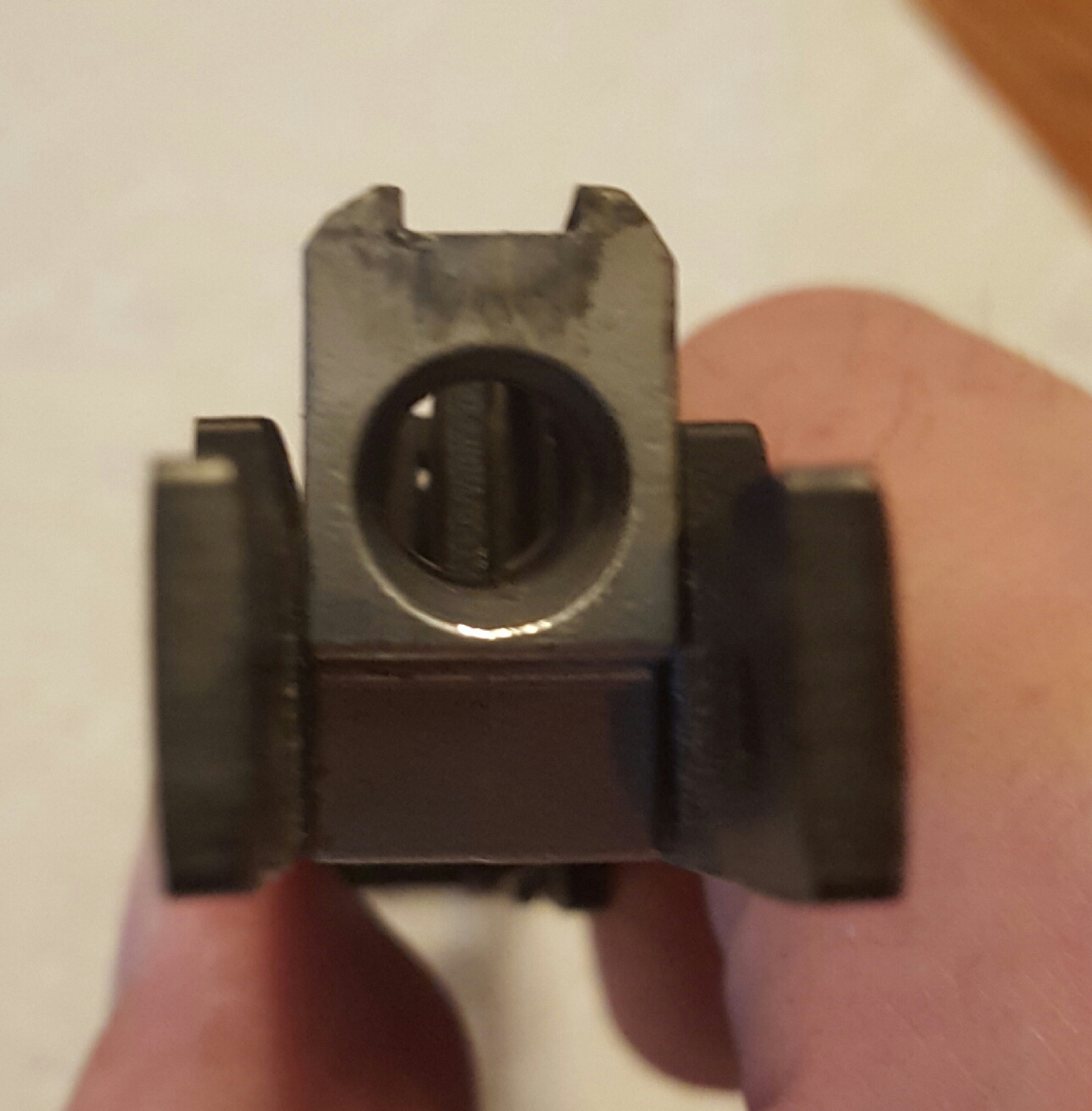
Front view -- old feed throat on right. Note that the old feed throat is angled on both sides, while the new feed throat is squared off on one side. As described below, the new feed-throat will need to be filed down to be angled on both sides.

Back view -- old feet throat on right. You will notice that the old feed throat includes an ejector, while the new one does not. Instead, the new feed throat uses part of the lifter spring to act as the ejector--it fits into the slot visible to the left on new feed throat.

Side View -- Old feed throat on top

You can see some of the differences between the old and new feed throat designs in the photographs above. Of course, one of the differences is the fact that the old feed throat is a two-piece design that is held together with a single rivet. As the photograph of the back of the feed throats illustrates, the two halves can be forced apart slightly (at least in my specimen), which I believe to be the cause of the feeding problem.

Another difference you will note is that the older design has three knobs or studs projecting from the sides, which fit into holes in the side plates of the action. These knobs hold the the feed throat in place. However, the new feed throat has 4 knobs. Obviously, the fourth knob (if you are looking at the feed throat from the front, it is the front-left knob, roughly corresponding to the location of the rivet in the old design) will need to be removed.

In the side view, you can easily see a third major difference, which is that the old feet throat has an integral ejector cast into it. There is no corresponding feature on the new feed throat. Instead, one of the tails of the lifter spring fits into a notch in the back of the feed throat (you can see this in the middle photograph) and projects slightly over the top of the feed throat, thereby serving double duty as the ejector.

Finally, looking at the front view, you will notice that in the old feed throat, both sides of the top of the feed throat are angled. These match up with angles cut in the bottom of the bolt. But on the new feed throat, one side (the left, as viewed from the front) is squared off. This will also have to be shaped with a file to fit into the old bolt.

The instructions below will tell you when to make the modifications to the new feed throat.

Differences Between the Lifters and Springs

There are also differences between the lifters and springs.

Old Feedthroat, Lifter and Spring

New feed throat, lifter and spring

As you can see from the photographs above, the old cartridge lifter is longer and shaped slightly differently from the new cartridge lifter. The old cartridge lifter will NOT work with the new feedthroat. Although the old cartridge lifter will fit into the new feedthroat, it will not depress far enough for the bolt to travel freely over the feed throat. You must install a new cartridge lifter.

The springs are also different. On the old spring, the two tails (or arms, if you prefer) are close to the same length. One tail has the end sharply bent to one side, and fits through a hole in the side plate to anchor the spring. The other tail fits underneath the cartridge lifter.

The new spring has very different lengths of tails. The short tail, with the sharply bent hook, actually fits under the cartridge lifter. The other tail fits into a groove at the back of the feed throat, and projects slightly over the top to act as the ejector.

Disassembly and Removal of the Old Feedthroat Parts

After making sure that the firearm is unloaded, turn the firearm over so you can see the bottom of stock and trigger guard, so you can see the screws that hold the receiver and stock together. At least on my particular specimen, the slots of the screws are each different sizes, so you will need at least three screw drivers or screw driver bits with varying widths and thicknesses of blades. It is easy to mar the screws if you do not use the correct size of screw driver bit.

Bottom of firearm -- remove the circled screws
As you can see, there are three screws through the trigger guard (at least in the particular model I own) and larger headed screw forward of the trigger guard. Only the three right-most screws need to be removed.

Screws removed
With those three screws removed, the barrel and action should pull away from the stock and trigger/trigger guard assembly.

Back of Action 
Front of action

At the front and back of the action are screws that hold the action to the receiver and barrel assembly. Remove these. As with the other screws, the size of the slots are different, and you will need at least two different sized screw drivers or screw driver bits.

Screws removed.
With these screws removed, you should be able to pull the action loose from the receiver/barrel assembly. Be careful as you remove it to pull down and to the rearward to clear the plunger in the tube magazine (or simply remove the plunger completely--i.e., turn and pull out the tube just as if you were loading the firearm). This plunger will be projecting into the hold on the front of the feed throat, and can be damaged or broken if you pull the action straight downward.

Useful tools for disassembly and assembly of the action. Left to right: a small upholstery nail puller,
 a straightened paper clip, and an awl. 
Some tools that will be useful are (1) a small upholstery nail puller (or you can use a flat screwdriver with a slot cut into the blade), (2) a paper clip or piece of wire, and (3) an awl or scribe. The nail puller will be used to press the hammer strut bridge (a small plate at the bottom of the hammer strut) and compress the hammer spring. The paper clip will be used to hold the hammer strut bridge in place so you don't have the hammer strut bridge and hammer spring go flying across the room. The awl will be used to remove and install a couple small c-clips.

Paper clip through a hole at the base of the hammer strut
Before going further, place the paper clip through a small hole you will see at the base of the hammer strut, as shown above. This will keep you from losing the hammer strut bridge or hammer spring.

The two c-clips to be removed

Next, remove the two c-clips shown above, so you can take off the right hand side plate. (Do not attempt to remove the other side-plate as most of the other parts are connected to that side plate, and it will greatly complicate reassembly).

Old feed throat, lifter and spring
With the right side plate removed, the feed throat and lifter will be exposed, and can be easily lifted out.

Old Lifter Spring. As you can see, one part of the old spring fits into a hole in the side of the action, while the other "arm" fits under the lifter.

At this point, you will need to grind off the extra knob on the new feed throat. The metal is soft and non-ferrous. So, if you are using a power grinder, be careful as the metal will be removed quickly and without the usual spray of sparks thrown off by steel to warn you when the grinding wheel has contacted the metal.

New feed throat with knob ground down

Next, put the new spring on its pin.

New Spring. The new spring does not fit into the side of the action at all. Instead, the longer "arm" will fit into the groove on the back of the new feed throat to act as the ejector, while the shorter "arm" fits underneath the new lifter.
Then place the new feed throat into place, and position the long tail of the lifter spring into the groove on the back of the feed throat. With that done, it is time to push the lifter arm into place. The small hole in the lifter goes over the pin to the far left of the photograph, above. Obviously, the front part of the lifter must slide first into the feed throat. I found it easiest to hold the feed throat in place (you can hold it with your hand, or wind a rubber band around it), hook the short tail of the spring into place, and then push the lifter forward and down (at an angle) into the back of the feed throat, and then maneuver it into place into the pin at the rear of the lifter.
Orientation of the new lifter and spring. Remember, though, that the short "arm" of the spring (to the left in the photograph above) will need to go under the lifter.
If you have not done so at this point, wind a rubber band around the feed throat to hold it in place.

New feed throat, lifter and spring in place. You can see the bit of the spring that fits under the lifter above, as well as how the longer arm of the spring fits against the back of the feed throat, and protrudes over the top, to act as the ejector.

Reassembly

I found the reassembly after this point to be the trickiest part, simply because of the difficulty of compressing the hammer spring so you can fit the tabs on each side of the hammer strut bridge into their respective holes.

Although you may find an easier method, this is what I did: Using the upholstery nail remover, place it so the strut will fit up through the cut in the blade, and push it (compressing the hammer spring) until you can fit the tab into its hole in the left side plate. Then put the right side plate over the right tab of the hammer strut bridge, and, holding it tightly together, shift the side plate around until you can fit it over the other pins that hold it in place. If your experience is like mine, you probably are best doing this step away from children because you will likely be cursing a lot. Be mindful that the paper clip stays in its hole, or you may see the hammer strut bridge and hammer spring fly across the room!

Once the side plate is on, use a second rubber band to hold it in place, and push the two c-clips into place. You can then unwind the second rubber band. You will probably just have to cut the first rubber band loose from around the feed throat. Finally, remove the paper clip.

Back together!
If you have not done so previously, it is helpful at this point to remove the bolt from the receiver to help with the final fitting and shaping of the feed throat. Putting the bolt into its rearmost position over the action, you will notice that the bolt will not ride over the new feed throat. This is, as I mentioned earlier, because one side of the feed throat is squared off rather than angled. Look at the bolt and feed ramp from the front, and you will be able to see what I'm talking about.

At this point, you will need to take a file and shape an angle into the side of the feed throat. Again, the metal is soft and easily removed. So stop often and check against the bolt. Don't take off too much material. When it is done, the bolt should ride over the feed throat without lifting up. You do not need to do any shaping of the rear of the feed throat or the side that is already angled.

One thing I found is that the lifter spring/extractor scraped and caught against the bolt. I had to bend the spring down slightly so it wasn't angled so steeply. However, check your bolt before you do this. You don't want to end up having to order a new spring.

Once the bolt rides fairly smooth, you can put the bolt back into place and finish your reassembly. Reassembly from this point forward is the opposite of the disassembly. Again, be careful of the plunger in the tube magazine.

Further Thoughts

As some of you may know, I had previously written up this project, and wound up having ejection problems. My error in my previous attempt was thinking that I could mix parts, using the new feed throat but the old spring and lifter. As I mentioned, the old lifter does not depress far enough to let the bolt clear. However, it was not immediately obvious to me that this was the problem. So, I ground too much off the new feed throat, including on the back of it. By the time I figured out what was wrong, I had removed the cut in the back of the feed throat for the lifter spring/ejector. 

Of course, I didn't know what problems that was going to cause because I didn't realize that the spring also acted as the ejector. I simply replaced the old lifter with a new lifter, and used the old spring. As I reported in my earlier post, when I took the rifle out to test fire, I had no more feeding issues, but it now wouldn't eject. Looking into the issue further was when I realized that the change in design of the feed throat included a change in the ejector. So, the end result is that I had to order a new feed throat and do the whole project over again. 

Currently, I have tested the feeding by hand, but I haven't had an opportunity to go out shooting. I will report on any issues that I have. However, the ejection seemed pretty positive when operating the bolt by hand, so I'm confident that the ejection issues are solved. And since the replacement of the feed throat last summer had solved the feeding problems, I anticipate that those issues are also resolved.

Obviously, ordering a new feed throat kit (the feed throat, lifter, and spring) is a significant cost relative to the cost of a used Marlin 60. So my hope is to see if there is some way to fix the old feed throat to improve reliability. That will probably be a project for this coming summer. 

If you have any experiences or thoughts you would like to relate, please comment.

Update (3/2/2015): I took the rifle out shooting this past weekend and put about 100 rounds of a couple different brands of standard .22 lead round nose through it without any failures to feed or extract. So, I consider the project a success.

Update (6/17/2015): Last Friday, a reader emailed asking when my Marlin Model 60 was manufactured. Interesting question. I knew that the particular model I used in my article dated from before the mid-1970's, but not the particular year of manufacture. In making a quick search, I came across the web-page for a company calling itself the Antique and Collectible Firearms and Militaria Headquarters which had several resources for determining manufacture dates for various manufacturers, including Marlin. It stated that, for Marlin firearms made between 1969 and 1990, "[t]he first two digits of the serial number designate the year of manufacture, either as the last two digits of the year (in 1969-71) or as a number code (1971 and later)." According to my reader, the system for 1971 and later was to subtract the first two digits of the serial number from 100 and that would give you the year (in a 2-digit format). My particular model was made in 1970.

Update (9/9/2015): I expanded the descriptions as to a few of the photographs to give more of an explanation of the differences between the old feed throat and spring, and the new feed throat and spring.

Update (11/30/2015): I had the rifle with me this past weekend, shooting in temperatures between 20 and 25 degrees Fahrenheit. Out of approximately 50 rounds, I had two failures to eject ("smokestacks") and one where the bolt cycled far enough to eject the spent casing, but not enough to pick up a new round. Considering the temperatures, and that the gun had been sitting in the cold while I used other weapons, I thought it did pretty well.

Update (10/15/2016): I had a request asking for additional photos of the feed throat after the shaping allowing it to use the old bolt. So, without further ado:


Update (8/11/2018): I saw on a forum that cited to this article that there were complaints about the photograph showing the fully assembled rifle at the top of this article. Accordingly, I have replaced it with a new photograph that better shows the rifle.

Ebola Outbreak Still Not Under Control

The ongoing Ebola outbreak is "resurging" in Guinea, where the virus has killed about 200 people since it appeared in February, and in neighboring Sierra Leone, said Doctors Without Borders on Wednesday.

Health workers appeared to be making progress against the outbreak, but Guinea and Sierra Leone are now reporting fresh cases, some in areas previously unaffected by the disease, said the doctors group, known by its French acronym, MSF.

MSF said it has seen more than 20 new cases of Ebola at its treatment centers in Guinea in the past week.

MSF said areas like the capital, Conakry, and the towns of Gueckedou and Macenta, near the border with Liberia, have seen a spike in the number of new patients.

But Ebola is also cropping up in previously unaffected towns, such as Telimele, north of the capital, and the coastal town of Boffa.
 This is a disease that normally burns out quickly because it is so lethal. That is apparently not the case with this most current outbreak.

Ukraine Shot Down Russian Drone With Laser

From CBS News: " Ukraine says it has intercepted a Russian jet-powered drone with a laser for the first time ." From the lede:    ...