Happened across a useful resource: "An Ax to Grind: A Practical Ax Manual" published by the U.S. Forest Service. It covers the basics of using an axe, including chopping techniques and cuts, as well as covering topics of felling a tree (just the axe use, though, not correctly judging how a tree will fall and other safety issues), limbing a log, cutting pinned down saplings, bucking (cutting a log into usable lengths), splitting wood, and hewing (shaping a log).
Showing posts with label Books/Articles. Show all posts
Showing posts with label Books/Articles. Show all posts
Wednesday, August 26, 2026


Saturday, April 18, 2026
Dalrymple Misses The Point
Theodore Dalrymple has published a book review, entitled "We Shall Not Fight on the Beaches," of Jean Raspail's dystopian novel The Camp of the Saints. Raspail's novel, published in 1973, is of a France too full of guilt and self-loathing to drive off a flotilla of immigrants sailing from the slums of India to France; and when the immigrants do land, it results in the collapse of France and Western Civilization, generally.
Dalrymple's essay begins well enough, roughly describing the book and the reaction it has engendered among those same elites which are condemned in the novel. But at the end of the review, Dalrymple faults Raspail for selecting Hindus from the slums of India as the invading hordes rather than Muslims, which turned out to be the hordes that ultimately invaded Europe. He writes:
But there were some things that he did not foresee—or if he foresaw them, omitted to mention. Chief among these was his failure to foresee or mention the peculiar difficulties for Western countries posed by large-scale Muslim immigration. In making Hindu Bengalis the Trojan horse, he was startlingly, almost diametrically, mistaken. Hindu immigrants have never created difficulties anywhere; and, oddly enough, it is Eastern, Muslim Bengalis, not Western, Hindu Bengalis, who have established a vast ghetto in London’s East End, and have profoundly corrupted the local politics. A member of the British Parliament, who was elected in a constituency in which Muslims were a majority, on a platform that made Gaza the most important issue, recently made a speech in which he called on Muslims to remain united in the face of the enemy—the very West to which they had emigrated.
I can understand why Dalrymple focuses on the Muslim hordes, but I think it misses the overall point made by Raspail. Raspail could have picked most any people for his horde when he wrote his book. At the time, though, India was the poster child of overpopulation, overcrowding, and revolting slums. The overcrowding of Muslim cities, such as Cairo, had not yet occurred; and neither had Africa yet seen its population start to explode.
But the idea behind the book is not that there was something particular about the population he had picked for his invading horde. Rather, it was that they were not Western and did not appreciate Western Civilization. They were barbarians, but of a different sort than had previously shown up in history. Not warriors that militarily destroyed a civilization but a vast unthinking horde that washed over a France (and, by extension, the West as whole) like a tidal wave. They were Indians in his book, but could have just as easily been Africans or, in the early 1970s, starving Chinese peasants. His book wasn't a warning about Islam because it was more broadly a warning of mass migration, particularly from non-European peoples, into Europe.
The Gates of Vienna actually has a good article about this entitled "The Varieties of Cultural Enrichment" which, while acknowledging that "[t]he Islamic variety [of enrichment] may be the worst, ... there are other contenders constantly vying for the title." Or, to put it another way as I saw in recent meme: "If local panda numbers were declining, you would never just bring in a bunch of cockroaches & say[ ] things are good bc 'the number of animals is growing'."
And the reason that any third world people could have been the horde in the novel is because the real warning of the book is not about the horde, for there are always barbarians trying to force their way through the gates, but about the people that not only left France (and the West generally) helpless and prostrate before invaders that could have been easily stopped at any time before they arrived, but reveled in the destruction of the white race.
Tuesday, July 22, 2025
The Ghost and the Darkness and .303
The Ghost and the Darkness is a 1996 movie starring Val Kilmer and Michael Douglas. It is ostensibly the story of John Patterson (played by Kilmar)--an engineer sent to design and oversee the construction of a railroad bridge in 1898 over the Tsavo River in what is today Kenya--and his efforts to hunt and kill a pair of man-eating lions that were feeding on the workers. The movie was good and, since I first saw it, I had been interested in tracking down Patterson's book.
A couple months ago I watched the movie again and afterward found that his book was available for the Kindle. Notwithstanding the title, The Man-Eaters of Tsavo, the book actually covers much more of Patterson's experiences in East Africa while working on the Uganda-Mombasa railway than just the story of the two-lions. The story of the two man-eaters is only about the first third of the book and, unsurprisingly, very different from the movie. The movie, in fact, is pretty much fiction. The lions were a problem--according to Patterson they took and killed pretty much one worker a day during the times they were around the work crews--but labor disputes threatened the project more than the lion attacks.
The movie character Charles Remington (played by Douglas) was apparently made up whole cloth. The railroad financier that berates Patterson in the movie also makes no appearance in the book--it appears that Patterson had no issues with higher-ups.
Other events portrayed in the movie are sensationalized or taken from events that occurred after the two lions were killed. For instance, one of the creepier scenes in the movie is when Patterson and Remington, while attempting to track the lions, stumble across a cave used by the lions as a den or shelter. In the book, Patterson did stumble across the lions' cave, but this was by accident and after the two lions had been killed. He did note that it was filled with many human bones--apparently bodies that the lions had dragged back to the cave to consume, some still with native jewelry on the bones.
While the movie was intended to be a somewhat creepy, disturbing story, the book was quite different in tone. It is obvious from the book that Patterson had two great loves: engineering and big game hunting. The book is mostly about the latter--and Patterson seems to hunt almost all of the dangerous game Africa has to offer--but offers descriptions and mention of his work designing and overseeing construction. And it is a type of travelogue as well, even ending with recommendations and advice (and prices) for someone wanting to travel to East Africa to hunt big game.
As a firearms aficionado, I was interested in the weapons used by Patterson, his compatriots, and the African and Indian workers and assistants. My biggest surprise is that, other than a couple occasions when he borrowed a larger double rifle or made use of a shotgun, almost all of his hunting--including the lion hunting--was done with a .303 Enfield bolt-action rifle. I've read of other hunters of that era using smaller, high velocity calibers, but I was nevertheless surprised.
Patterson's willingness to use the smaller bore rifle also seems to fit into his character and the general attitude at the time (at least in East Africa): danger and risk seemed to be welcome and even a source of humor, and death and injury was too common to mourn or obsess about.
Anyway, if you've seen The Ghost and the Darkness or like books on big game hunting, the British Colonial period in Africa, or just a good memoir, I think you would enjoy Patterson's book.
Friday, November 8, 2024
Weekend Reading: New Weekend Knowledge Dump from Active Response Training
Greg Ellifritz has a new Weekend Knowledge Dump up and ready. Some of the articles that caught my attention:
- An article that compares .22 LR with .22 Magnum for hunting and home defense, including ballistic tests. For those interested in it for home defense, the authors have this to say: "If you’re set on using the .22LR for self defense, we recommend the CCI Standard Velocity 40gr. LRN. Out of a rifle, the bullet will travel around 1000 to 1200 fps, defeat 4-layer denim, and penetrate deep enough to hit vital organs. The round can also be effective out of a pistol, but it will likely require precise shot placement and multiple rounds."
- An article from Dave Spaulding at Tactical Wire on "Situational Shooting." Lots of good points and advice, but this stood out to me: "The truth is, most shooters are more accurate when they move rapidly and stop/plant to shoot, versus trying to shoot while moving." To back this up, the article quotes from former Delta Force operator Paul Howe relating that he either was running too fast to get to cover to shoot, or he would stop, plant, and shoot--there was no in between.
- Greg has included an article from Clint Smith on point-shooting called "Point-less shooting". Smith begins his article: "I’d say it’s pretty tough to shoot a handgun instinctively, since no one I ever met dropped from the womb handgun in hand. Should it ever happen, there then I guess would be someone with the potential to be an instinctive shooter." I have to disagree a bit with this point (no pun intended). Pointing your finger is instinctive, and with a firearm that fits you, if you point your finger at the target while your pointer finger (i.e., trigger finger) is alongside the frame, the barrel should be basically pointing where ever your finger is pointing. Not good enough for long or even medium distance work, but perhaps good enough at close distances. I'm not encouraging point shooting, but to say that where is nothing instinctive about it is not completely correct either.
- Another article included is "Understanding Vision, Cognition, and Response: The Complexities of Reaction Time in the Real World." It's always good to understand how you (or others) are going to act and react under pressure.
- Organic Prepper recently published an article on recommended books for your medical library (if you are a prepper) which Greg links to while adding a couple of recommendations of his own.
Wednesday, October 23, 2024
Greg Ellifritz Discusses Institutional Memory And The Shooting Arts
Greg Ellifritz has published a new article at his Active Response Training blog on "Institutional Memory." The gist of the piece is that too many trainers and students don't know of the pioneers of defensive shooting or even of the many that have further pushed it along and developed the art of self-defense with firearms. As an example, he notes that when he mentioned in two recent classes that Ed Lovette had died, none of his students knew who he was.
But perhaps more importantly, not only are many students ignorant of the identity of these pioneers and past teachers, but they don't know what they contributed or taught about shooting. And because of that, they lack the "institutional knowledge" that would come from studying this prior work, including what worked and what hasn't. And the problem with forgotten lessons is, as Greg points out, that sometimes the art regresses when some new fad gets picked up that had previously been tried and found wanting.
Greg points out that much of this problem lies with the fact that so many people get their knowledge on defensive shooting from the Internet, but the prior art, so to speak, is mostly to be found in old articles and books. To assist people with this issue, Greg has listed many of the significant books on shooting by past masters and some other resources. So be sure to check it out.
Sunday, June 23, 2024
Book Review: "After 1177 B.C.: The Survival Of Civilizations"

Book: After 1177 B.C.: The Survival Of Civlizations by Eric Cline (2024), 352 pages.
I reviewed Eric Cline's book 1177 B.C.--The Year Civilization Collapsed back in 2015. That book examined the causes of the Bronze Age Collapse and the nations caught up in that broad civilizational collapse: the Minoans-Mycenaeans in and around Greece and the Aegean, Egypt along the Nile and extending control into Canaan, the Hittite Empire controlling most of Asia Minor, the Mittani which occupied the northern Tigris and Euphrates river region, and the Babylonians. The impact was likely felt beyond even these kingdoms and empires as trade collapsed.
The gist of the book is that there was a perfect storm of events and causes that interplayed and magnified each other to lead to wide-spread disruption and collapse, as there is evidence of a centuries long drought (probably due to the climate cooling), several natural disasters including some earthquakes that destroyed a few major cities, resulting in famine, war, collapse of trust in institutions, collapse of long distance trade, social upheaval, and migrations of people leading to more conflict.
Although Cline and I use the term "collapse," that is not to say that everything regressed to the stone age. Rather this is a collapse in the sense that Joseph Tainter uses the term: a rapid decline in complexity of the civilization until the complexity reduces to a level where stability returns. In other words, while a society can collapse completely, it can also fragment or shed institutions without fully disappearing. Thus, it can occur at different times and to different extents.
In the case of Bronze Age Collapse, the Hittite Empire disappeared to never reappear. The Babyloniann declined but adopted and recovered a couple hundred years later. The Mittani were absorbed into the Assyrian Empire. The Minions-Mycenaeans society disappeared to reappear later as the Greeks and Cretens of the Archaic age. The Egyptian Empire went into a decline from which it never fully recovered although it also did not collapse. Some of the territories over which it established control became independent and actually seemed to thrive during the dark ages that followed the collapse, such as the Phoenicians who developed a trading empire and, more importantly, spread their alphabet around the Mediterranean. The collapse of the international tin trade also drove a shift from bronze to iron.
After 1177 B.C. explores what happened to the major civilizations and cultures after the Bronze Age Collapse and the next 200 to 300 years. While Cline takes a "glass is half full" approach, emphasizing that the Collapse did not mean the complete loss of civilization, but that cultures adapted--some even thrived--with comparable complexity and international trade reappearing between 200 and 300 years later, depending on the location.
That doesn't mean that it was an easy transition. Cline notes, for instance, that "there was a dramatic drop in population on mainland Greece immediately after the Collapse." Recent estimates indicate a decline in population of between 40 and 60%! To put that in context, that is greater than the die off from the Black Plague in the 14th Century. That is merely one of many societal changes. Cline identifies seven (7) changes:
- The collapse of central administrative organizations;
- The disappearance of the traditional elite class;
- A breakdown of the centralized economy;
- A settlement shift;
- Population decline;
- Loss of writing (what I would characterize more accurately as a loss of certain technologies); and,
- A pause in the construction of monumental architecture (which is a symptom of the loss of centralized authority--with its taxing power--and decline of the elites and overall disappearance of wealth).
In this respect, Cline writes:
Joseph Tainter notes that a systematic collapse of a civilization or society is also usually thought to bring an end to "the artistic and literary features of civilization, and to the umbrella of service and protection that an administration provides." As a result, he says, "The flow of information drops, people trade and interact less, and there is overall lower coordination among individuals and groups. Economic activity drops ... while the arts and literature experience such a quantitative decline that a dark age often ensues. Population levels tend to drop, and for those who are left, the known world shrinks" All of this is usually seen as a fearful event, "truly paradise lost." However, according to Tainter, sociopolitical collapse is quite a normal occurrence and even to be expected in the general course of the life of complex societies.
But while a dark age followed the Bronze Age Collapse, Cline contends that the question in studying such a period is "'dark' for whom and in what respects?"
This is the question at the heart of our explorations. What was it like for those living in the aftermath of the Collapse, and how was it different in each of the affected areas? What did it take to survive?
Cline then explores different the different regions and what happened in each region, rather than simply address all regions in a chronological fashion. First he examines the fate of Egypt, Israel, and the Southern Levant. Second, Assyria and Babylonia. Third, Phoenicia and Cyprus. Fourth, Anatolia and Northern Syria. Fifth, the Aegean region.
Egypt was the only one of the prior great powers that survived with any substantial continuity of government. But the pharaohs that rules following the Collapse oversaw a permanent decline in the power and influence of Egypt. They were faced with disruptions and upheaval within their borders taking the form of an significant jump in tomb robberies (this was the period that Egyptian officials were forced to gather up mummies from scattered tombs and hide them), famine and food shortages, in-fighting among the elites, and "disruptions" caused by foreigners (probably both migrants and slaves) inside Egypt. As Cline put it, the Egyptians "were able to cope and continue to exist but really failed to make the transition properly, neither adapting particularly well nor transforming at all."
Of course, Egypt's loss was another's gain. Losing its control over Canaan, it appeared that the mantle of control would fall on the Philistines, but it was actually the Israeli kingdoms that emerged the dominate power over Canaan in the wake of the invasion by the "Sea Peoples". The success of the Philistines and Israel were helped along by climate: although much of the region was gripped by a centuries long drought, the southern Levant experienced an uptick in moisture starting around 1150 to 1100 B.C. and lasting until about 950 B.C. permitting intense cereal and olive cultivation. In fact, newer research shows that the Levant may have been one of the few areas to experience in increase in population during the post-Collapse dark age. But as minor kingdoms, the Israelite kingdoms only flourished until other larger regional empires arose again.
Turning to his next region, the upper and lower regions of the Tigris and Euphrates Rivers, Cline observes that "[o]verall, the Assyrians and the Babylonians proved to be among the most resilient and successful of the affected societies to weather the aftermath of the Collapse," being able to retain writing, keeping their systems of government, and even able to engage in some massive building projects. Nevertheless, they did not escape unscathed, as Cline writes, pointing out that "archaeological evidence obtained from surveys in the region of ancient Babylonia suggests that there may have been a decrease in population of up to 75 percent during the three hundred years between the Collapse at the end of the Bronze Age and the beginning of the Babylonia resurgence after 900 BC." As for the Assyrians, it is notable that there were almost no royal inscriptions during the period from 1208 BC to 1133 BC. Nevertheless, Assyria was able to grown and expand swallowing up the city-states and smaller kingdoms that arose after the Collapse. As Cline writes:
Without any strong competitors, Assyria eventually filled the political void to become the most resilient large state recovering from the Late Bronze Age Collapse. In doing so, the Assyrians invented many of the elements that were adopted by later empires: standing armies, effective communication and transportation systems, and policy propaganda (like the Balawat gate inscriptions).
Cline next examines the Cypriots and the Phoenicians. The Phoenicians took the advantage of the sack of other port cities during the Sea Peoples invasions to win control of the trade routes across the Mediterranean Sea, "spreading their version of the alphabet, and exchanging trade goods such as purple dye for silver and other metals coming from as far away as Sicily, Sardinia, and Iberia." The Cypriots similarly spread iron goods and iron technology east and west. "Together," Cline contends, "they were the two societies that weathered the transformation to the new normal most successfully; both could even be labeled as anti-fragile, flourishing during the chaos that followed the Collapse."
Cline next examines Anatolia and Norther Syria--areas dominated by the Hittites prior to the Collapse. Cline indicates that the Hittite Empire in Anatolia had collapsed and disappeared almost completely in the years after 1200 B.C.
The capital city of Hattusa was initially abandoned and then partially destroyed, with a small Iron Age village subsequently established on one small portion of the original city. The situation has been recently summed up by Lorenzo d'Alfonso of New York University and his colleagues as follows: "A deep transformation took place in the former core of the empire around the capital Hattusa, resulting in a drastic decrease in political complexity, a shift to subsistence household economy and a lack of evidence for any public institutions." Furthermore, James Osborne, a professor at the University of Chicago, cites recent research stating that there may have been "a drastic settlement drop of about 90%" in south-central Anatolia at this time and says that "despite evidence for continuity in certain locations ... the general picture is one of marked decline and social complexity until the ninth century."
What is significant about the 9th Century BC is that when the drought that played such a large role in the Bronze Age Collapse ended, when the climate returned to one that was warmer and wetter.
Nevertheless, "despite the collapse of the Hittite Empire proper, we can see that there were survivors and that life did continue, especially in the hinterland, even if the centralized government and its attendant bureaucracy and administration had essentially vanished, leaving the various areas to their own devices." In addition, some remnant of the Hittite royalty apparently retained some control over as many as 15 city states in northern Syria. And while the region appears to have suffered the most from the invasion of the Sea Peoples, most sites were almost immediately reoccupied following the destruction and resumed agricultural, industrial, and trade activity. Eventually, however, this area fell under the influence of the Assyrians.
Mycenae on the Greek mainland similarly fully collapsed, although not as quickly. Cline notes that "[i]t is now clear that it took more than a century for the last vestiges of the Bronze Age Mycenaean palatial society to fade away and the succeeding culture of the Iron Age to begin on mainland Greece." The primary cities were largely abandoned, but life appears to have continued in the countryside, albeit free of a centralized government control and within a simpler economic environment. This wasn't necessarily a bad thing for the commoner: as Cline notes they were freed from the overwhelming taxation to support the palatial elites and their projects, "such that some rural areas may have actually experienced a brief moment of prosperity in the decades immediately after the Collapse." But the collapse of the urban centers also led to the loss of writing for centuries as well as the loss of the representational arts and crafts. "The complex forms of political, social, and economic organization fell into oblivion. Palaces, kings, and royal families became matter for Greek myths." "In short," Cline concludes, "Greek civilization was reduced to the level of a prehistoric society." Thus, while there were survivors, "it was not until the eighth century BC at the earliest that we can talk about Greek culture resuming on a path that led to more than simply basic subsistence and scratching out a living."
In summing up his book, Cline writes:
Painting with broad brush strokes, what we see in general from the twelfth century BC onward is a fragmentation and decline in security and material standards of living in the years immediately after the Collapse, continuing down through the tenth century or thereabouts, as the Bronze Age kingdoms fell apart. In the areas that were affected to the greatest extent, including mainland Greece, Crete, Anatolia, and the southern Levant especially, there was a collapse of the local palaces, states, or kingdoms (including government, centralized economy, and so on) even if segments of the population managed to survive.
However, reintegration then begins during the ninth century and continues through the eighth century...
To put it another way, and to emphasize the material side of things, in general the period from the twelfth through the tenth centuries BC saw population crashes, abandonment of cities, violence, probable migrations, the collapse of trade routes, disease, earlier ages at death, falling economic output, lower standards of living, and the loss or decline of advanced skills, though the extent varies depending on where one looks in the region. In contrast, the period from the beginning of the ninth century BC onward saw many of these trends reversed. By the time we reach the second half of the eighth century BC, we see new life and innovations in many of the areas, and a fully interconnected world begins to take shape once again for the first time in several centuries.
He sees the Bronze Age and its subsequent collapse and recovery fitting into what is termed the "adaptive cycle" with the early part of the Late Bronze Age representing the Exploitation phase, the Late Bronze Age as the Conservation phase, the Bronze Age Collapse as the Release phase, and the subsequent Iron Age is the Reorganization phase which, will, eventually start the cycle over again--in this case, the Archaic age followed by the Classical age.
Cline also examines why some cultures seemed to weather the collapse better than others. Some of it may have been a matter of luck: located in an area that was not as affected by drought as others, being shielded from the attacks of the Sea Peoples, better leaders, more redundancies in their state administration, or armies better able to fight off raiders or conquer neighbors. But he notes, at least as to the Assyrians, that "they may have proved to be resilient because of four things that they were able to retain for whatever reason: their centralized government, still led by the king; their basic economy; their writing system; and their army."
But the main lesson that Cline wants to emphasize is that "Collapse can involve both the end of old social institutions and the beginning of new ones."
Unfortunately the archaeological record is too incomplete to come to firm conclusions as to why one culture did better than others. Unlike Cline, I think luck played a major role both as to climate and to which areas were subject to invasion or attack by the Sea Peoples. Some must have been due to the cultures--some were more, perhaps, fatalistic and others more adaptable by nature. I suspect that the relationship between the people and their elites played a role. That is, that elites that maintained their legitimacy even in the face of drought, disaster, or war, were more likely to continue their rule; and for those hated by their populace, the events of the Collapse provided an excuse for their elites "to disappear". Unfortunately, while the loss of elites may have been a temporary boon in those civilizations that were heavily taxed, it also didn't help with recovery (although the conflict among elites in Egypt appears to have been almost as crippling to recovery).
And while there are no guarantees, it appears that on an individual basis, living in a rural area that provided water and arable land was vital; and combined with access to trade and trade routes was ideal.
Thursday, June 6, 2024
Book Review: Derelict For Trade by Andre Norton and Sherwood Smith

Book: Derelict For Trade by Andre Norton and Sherwood Smith (1998), 283 pages.
Andre Norton, as some of you probably know, was one of the most prolific science fiction and fantasy authors of the 1950s - 1970s. Although not producing anything as deep or weighty as other authors of that era such as Asimov, Heinlein, Clarke, or Herbert, she produced generally good yarns suitable for a teenage audience.
A couple of my favorite books when I was an early teen, in fact, were by Norton: Daybreak 2250 A.D. (a post-apocalypse novel which I've previously reviewed) and Sargasso of Space. The latter book recounted the exploits of the fictional Dane Thorson, a new graduate of the space equivalent of the merchant marine, who joins the crew of the "free trader" Solar Queen--a small starship serving as an independent trader and freight vessel along the fringes of human space, combining elements of exploration, the age of the Yankee trader, and the Western/cowboy genre. Andre Norton went on to write a couple more Solar Queen novels including Plague Ship and Postmarked the Stars, as well as a novella entitled Voodoo Planet. As befitted the time period and intended audience of teenage boys, the primary protagonist in the books was the young Dane Thorson.
In the 1990s, three more books were introduced to the series, each written with the help of another writer. The first, which I have not read, was Redline the Stars (1993), written with P. M. Griffin, and the latter two were Derelict for Trade and A Mind for Trade both published in 1997 and co-written with Sherwood Smith. I recently finished Derelict for Trade.
As a stand alone book, Derelict for Trade is an acceptable space opera adventure. The crew of the Solar Queen exits hyperspace into a new star system running on fumes and low on cash when they hit something that throws them on a collision course with the primary habitat in the system, facing the choice of possible destruction or losing their ship to pay off rescue fees. Fortunately, though, the object they collided with is a derelict ship. Able to syphon enough fuel off the derelict ship to regain control of the Solar Queen, they dock at the habitat (inhabited mostly by humans and two alien species, each with different gravity requirements). The crew then begins the process of claiming salvage on the derelict and scrounging up a new cargo to haul before the docking fees eat up their available cash.
But there is something off about the history of the derelict. Although apparently lost months earlier according to the official records, there were two cats on the derelict that had been abandoned for no more than a few weeks; and a hidden data storage found in the hydroponics room refers to a ship with a different name.
As the crew unravels the mystery of the derelict while navigating a bureaucracy involving alien species and cultures, they uncover a massive criminal conspiracy involving piracy, hijacking, and fraud. And we get a look at what life in an O'Neill Cylinder might be like.
Like I said, a solid if somewhat predictable book suitable for a teen audience.
What I didn't like about the book, though, was the shift from an adventure story for boys to one oriented toward girls. First, the story shifts from having Dane Thorson as the primary protagonist to a female doctor/psychologist, Rael Cofort, who apparently joined the crew in the 1993 Redline the Stars. Although the Cofort character begins the book as a typical "Mary Sue" the author wisely pulls back from this as the book continues. But counterbalancing this, Thorson is initially downgraded to a bumbling, introvert, although this also corrected as the story progresses.
Second, as befits a book intended for girls, the author interjects a romance. Not between Cofort and Thorson (or a crew members her own age) but with the captain of the ship, culminating with their marriage at the end of the story. I guess I should be happy that it was not written today, in which case the romance would probably have been between two (or more) homosexual characters and the danger and adventure would have been completely missing and replaced with some story revolving around taking down the patriarchy.
In any event, other than my two gripes (which really only apply to a male reader), it is a decent enough addition to the Solar Queen series--certainly better than Postmarked the Stars or Voodoo Planet if inferior to Sargasso of Space and Plague Ship.
Saturday, March 16, 2024
Book Review: "Fitzpatrick's War" byTheodore Judson

Book: Fitzpatrick's War by Theodore Judson (Daw Books, 2004)

I heard of this book on a Whatifalthist video discussing it as one of a few books imagining what the world might be like after a popular backlash against the elites.
Probably because of it being referenced by Whatifalthist, copies of the book are difficult to find and those that are available are selling for well over $1,000. Fortunately, thanks to inter-library loan, I was able to borrow a copy to read.
I will use modern political terms and references to explain the backstory even though those terms are not used by the author (in fact, his book predates certain terms in our modern political lexicon). WARNING: There will be spoilers.
There seems to be a couple main themes in this book. First, through the backstory or history, we get an idea of a possible future where the Left pushes too far prompting a backlash and return to conservative principles. In this regard, the author seems to draw heavily on the ideas of Oswald Spengler and other similar historical theories postulating that civilizations go through periods of vigorous and creative growth, but mature and eventually transform into corrupt, decadent cultures rules over by money interests until it finally collapses to start over again. The second theme is, assuming the cycle is correct, is there a way to arrest the cycle so that a civilization stays in the growth (or Springtime) stage?
The story takes place in the 25th Century, but gives a rough idea of the
upheavals of the 21st Century to understand the world of the main
characters. Although the book is described as post-apocalypse, it doesn't really fit into that genre. It takes place so long after the apocalypse, among a technological civilization, that it lacks the elements of survival, exploration and rediscovery of old technologies that I associate with a post-apocalypse story. It would be like describing a story set in Renaissance Italy as post-apocalypse because it took place after the fall of the Roman Empire.
Briefly, the background or history before the story begins starts in the 21st Century. At that time, the multicultural, woke, globalist blue states obtain near control over the people that Hillary Clinton termed "deplorables". Such is the contempt held for the farmers and other rural folks that they began to be derisively referred to as Yukons (in reference to that territory's remoteness from civilization)--a term that the "Yukons" take to describe themselves (similar to how Christian was originally a derogatory term but was adopted by the believers to which it referred). Although not detailed, the blue portion of the country are referenced as being in severe moral decline, ruled by the basest passions and perversions--much like today, I imagine. The people of the cities eventually elevate to power a group called the Yellow Jackets which seems to be a mixture of street gang and political party. Eventually, fighting breaks out between the Yukons and the Yellow Jackets, ending with a Yukon army taking Washington D.C. and killing the politicians and impaling the Yellow Jacket leader on a wooden stake (a la Vlad Dracula's favorite punishment for his political enemies).
This is not the end for there follows plagues and wars culminating in a Storm Times where special satellites operated by a secret society of Yukons called the Timermen are used to destroy all electricity and electrical devices.
The end result of this is a white, racially homogeneous Yukon Confederacy ruling over the former United States and Canada in North America, Australia, and New Zealand and a few other territories. The Yukon Confederacy is very much a conservative society (K-select for those familiar with Anonymous Conservative's theories) focused around God and Country with a strong and vigorous military and semi-feudal in nature. And behind the Confederacy are the Timerman--still operating satellites that dominate near earth orbit and provide both surveillance and communication services for the Confederacy, as well as limited navigational aid to specially equipped ships and aircraft. Because of their ability to destroy any electrical or electronic apparatus, the whole world (Yukons and everyone else) is relegated to non-electric technology: steam engines and other steam technology, chemistry (including advanced polymers), and so on. Apparently medicine is particularly advanced, but the only references to this is that most diseases had been eradicated and people--at least the Yukons--seem to have somewhat longer lifespans. Thus, there is a strong steampunk feel to portions of the story.
As would be expected extrapolating from current demographic trends, the Turks have formed a new Muslim Empire that has conquered all of Europe (although the Yukons are able to recapture and colonize the British Isles) as well as North Africa, and the Near and Middle East. It is not clear what happened to white Europeans--the book mentions the Slavs maintaining their Christianity, but indicating that England was bereft of people when the Yukon Confederacy captured it.
The Chinese also have an Empire that rules from Central Asia to the coasts of East Asia (including Japan). India appears to be the master of its subcontinent and most of Southeast Asia. Africa and Latin America are a collection of independent countries, with Africa seemingly reverting to its normal level of primitiveness.
The main characters of the story are Isaac Prophet Fitzpatrick the son of the Confederacy's consul (leading political leader) and part of a very wealthy and powerful family, and Sir Robert Mayfair Bruce, a poor, landless knight. Fitzpatrick's character arc is very obviously based on the life and death of Alexander the Great. However, Fitzpatrick's story is told through Bruce, who narrates the story (in memoir form) from his perspective as a sometimes friend and confident of Fitzpatrick. He essentially acts as Fitzpatrick's conscience throughout the book.
The story essentially begins when Bruce is invited into a close group of Fitzpatrick's friends when at the military academy, and having tied his fortunes to Fitzpatrick sees his star rise with Fitzpatrick's. As a very capable military engineer, Bruce finds himself involved in much of the action, although not as the leading general or strategist. But he is close to many of the key players and, therefore, is able to give his perspective on the key events.
The bulk of the story is about Fitzpatrick's rise to power (including assassinating his own father to become the new chancellor and virtual emperor) and the buildup to and actual war between the Confederacy and its ally, India, against the Chinese. The Chinese are handily defeated but with much devastation to China and India. Through this, Bruce becomes more and more a humanitarian.
The pace quickens (or the details drop off, however you want to view it) after this war as Fitzpatrick forms a worldwide empire, even going so far as to build a new capital city in central Asia. But like Alexander the Great, Fitzpatrick seems to take on a certain madness even as he tolerates more and more decadence among the wealthy elites. Since Bruce is one of the few people he trusts, he keeps Bruce close at hand. But this merely puts Bruce in the position to see the worst excesses of Fitzpatrick and the ruling elites. Bruce eventually agrees to participate in a successful plot to kill Fitzpatrick and much of his court.
After this, the book becomes more like a history book relating events that Bruce is distant from. Needless to say, an even more corrupt group takes control of the government, until economic decline and a new revolution drives them from power, returns their wealth and lands to the low level lords and essentially destroys the money class, resulting in a reinvigorated Yukon Confederacy.
And through this, Bruce finds his greatest love and satisfaction to be his wife, family, and humanity.
And thus we have the answer to the second theme to the book: how to reinvigorate slipping into its Imperial/decay stage. And that answer is to foster and support those elements that make it dynamic--the K-select aspects as expressed through military service, working the land, strong families and religious ties based around an ethnic nation--while eliminating those elements that corrupt society--large, dehumanizing cities and industries, moral degeneracy, the cosmopolitan and effete monied elites with the concomitant globalization of production and extreme disparity of wealth. And keeping life from becoming too easy through technology.
While Judson's book is very interesting and entertaining, the one flaw in his theory is that it required a secret cabal of technologically advanced savants to carry it off. A group that was wholeheartedly devoted to its mission but without being corrupted by the power they wield. It is not realistic: such a group would eventually become corrupted because it is human nature. The group would naturally evolve from playing God to believing they were gods.
Monday, December 25, 2023
A Christmas Ghost Story: "The Story of the Goblins Who Stole A Sexton" by Charles Dickens
Although we don't, today, associate Christmas with ghost stories, it appears to have been part of the general entertainment at some time. The quintessential Christmas ghost story is Charles Dickens' "A Christmas Carol," but here is a reading of another by Dickens (and quite a bit shorter). Although it involves "goblins," the story makes clear that they are spirits or some other incorporeal beings, so I think it falls within the category of a "ghost story".
Classic Ghost Stories Podcast - Tony Walker (30 min.)
Monday, December 4, 2023
Tuesday, September 19, 2023
We Know What Needs To Be Done: A Book Review of "End Times" by Peter Turchin

Overview: In this follow-up to his 2016 book, Ages of Discord (which I reviewed here), Turchin further explores his theory of the link between social unrest and the twin factors of elite overproduction and popular immiseration, this time better backed up by further development of a historical database and refined model on which he relies. He explains that the United States is currently experiencing popular immiseration and elite overproduction which set the stage for Trump's election in 2016, and will continue to breed social unrest and opposition to the elites until those two factors are addressed.
-------
John Wilder, in his Wilder, Wealthy & Wise blog, recently published a post entitled "We Already Know The Solutions," in which he posits that for most issues we face, we already know what to do. Not that we can look at a math problem, for instance, and immediately know the answer, but we know that if we want to solve the math problem we will have to put in the work and apply the rules of mathematics to solve the problem. The issue is generally more of will or overcoming some other aversion to doing what needs to be done. In his article, he focuses on the current issues we are facing of crime and uncontrolled illegal immigration and observes that we all know that to address these issues: we need to make the consequences of crime and illegal immigration so uncomfortable that the people involved in those activities turn to alternatives. For instance, illegal immigration could be solved by ejecting illegals from the country no matter their circumstances (or sob story); and if they have anchor babies, they can take the children with them or have the children go into foster care--but the illegal parents will still be ejected. It is just that solutions like these are currently unpalatable to the political class and the elites.
I had much the same feeling reading Turchin's book: he knew the solution, he even explains how it historically came about in other "ages of discord" but he does not explicitly state what needs to be done.
As an initial matter, to understand Turchin's theories, you need to understand what he means by "elites". "In sociology," he explains, "elites are not those who are somehow better than the rest. They are not necessarily those who are more hardworking, or more intelligent, or more talented. They are simply those who have more social power—the ability to influence other people. A more descriptive term for elites is 'power holders.'" (p. 3). "These are the people who concentrate most of the social power within a state in their hands. They are the ones who make decisions at the level of the whole society on matters such as war and peace, social and economic policy, taxation and redistribution of resources, and legislation and law enforcement." (p. 297). Although a somewhat broader term because it incorporates a larger faction of government and private bureaucracy, intellectuals, educators and so on, it is similar to Angelo Codevilla's term "the Ruling Class" which identifies the upper echelons of the elites.
Turchin's theory, in a nutshell, is this:
All complex human societies organized as states experience recurrent waves of political instability. The most common pattern is an alternation of integrative and disintegrative phases lasting for roughly a century. Integrative phases are characterized by internal peace, social stability, and relatively cooperative elites. Disintegrative phases are the opposite: social instability, breakdown of cooperation among the elites, and persistent outbreaks of political violence, such as rebellions, revolutions, and civil wars.
(p. 29). The integrative phases seem to be marked by more compact pyramids of powers with a relatively small number of elites compared to the greater mass of citizenry and if not prosperous, at least a population content with its economic position and prospects. On the other hand, Turchin's "analysis points to four structural drivers of instability: popular immiseration leading to mass mobilization potential; elite overproduction resulting in intraelite conflict; failing fiscal health and weakened legitimacy of the state; and geopolitical factors." (p. 30). Of these, he notes, intraelite competition and conflict is the most important factor; the other factors are less important and, in some cases--such as geopolitical factors--may be missing. However, in all of his examples, popular immiseration also played a key role. I would also note that the remaining three factors--fiscal health, weakened state legitimacy, and geopolitical factors, can be derived from or a symptom of the first two factors.
These alternating periods of integration and disintegration, he notes, tend to come and go in cycles, probably because they depend on generational issues: one generation of elites may learn their lessons from a period of instability, enact reforms, and marshal in a period of integration; but subsequent generations will forget or ignore those lessons, ushering in a period of disintegration and social upheaval. Thus, Turchin notes, "[t]his dynamic sets up a recurrent cycle of violence of roughly fifty years in length (that is, two human generations), which persists until the structural conditions are somehow resolved, leading to the next integrative phase." (p. 30). However, the length of these cycles are not set in stone. Nevertheless, Turchin indicates that his team has not identified an integrative phase of more than 200 years. (p. 29).
Of the factors leading to periods of instability, intraelite conflict is the easiest to understand because it revolves around elite overproduction. That is, there are only so many slots or positions available for elites. For instance, in a medieval kingdom, there is only one king and only so many princes, dukes, and so on, which can be supported beneath this. It was possible to siphon excess nobility into the medieval Church or a few other positions (a sheriff or bailiff or magistrate, for instance), but that can only go so far until there simply are not enough elite positions to take in the numbers of elites wanting those positions. When there are enough slots to go around, the elites can and will come to compromises, but when there are not enough slots there will be a growing number of frustrated elite aspirants that will form into what Turchin terms "counter-elites": those elites setting themselves up as opposed to the elites and willing to take advantage of popular immiseration and discontent.
Elite overproduction can come about in various ways. The most simple and direct method historically is simple reproduction: elites having many children which (because of their elite status) tended to be more likely to survive to adult hood. This is particularly a problem in polygamous societies (such as common in the Middle or Far East) because a king or prince, for example, might have many wives and produce a great number of offspring, all of which will vie for power. Thus these types of cultures tend to be more politically unstable. Alternatively, in modern society as well as Confucius China, elites can also be produced by a system of credentialization where access to ranks of the elites can be achieved through education and some system of selection.
The other key factor is popular immiseration: a general decline in well being of the great mass of people (the "deplorables" as Hillary Clinton described them), especially vis-à-vis the elites. We know from our study of history that the well-being of commoners can decline for many reasons outside the control of the elites: war, pestilence, natural disasters, changes to climate can lead to declining wealth, famine, or death. However, these types of black swan events do not, with the one exception of epidemics (whether of germs or memes), really factor into Turchin's analysis; probably because these are black swan events that can be weathered in an integrative phase and, at least in more modern times, are merely an aggravating factor during disintegrative phases.
Turchin instead focuses on declining relative wages and what he terms the "wealth pump." He explains:
The fruits of economic growth have to go somewhere. If the state’s revenues are a relatively constant proportion of GDP, while the wages of common workers claim a decreasing proportion, the fruits of economic growth will be reaped by the economic elites that include the top earners (e.g., CEOs, corporate lawyers) and owners of capital. It takes time, but eventually the wealth pumped from the common people to the elites results in elite overproduction, intraelite conflict, and, if not checked in time, state collapse and social breakdown. The rich are perhaps even more vulnerable than common people during such periods of social and political turbulence, as outcomes of social revolutions suggest.
(p. 81). Turchin notes that most elites do not particularly care about the fortunes of the non-elites, or "deplorables," because "[i]n most complex human societies, the upper classes feel a measure of disdain for the lower classes. 'The peasants are revolting.'" (Id.) But they should. He writes:
But then you should consider another and very serious reason why the declining well-being of the working class is a bad thing—because it fundamentally undermines the stability of our society. Most obviously, when large swaths of the population experience falling living standards, this undermines the legitimacy of our institutions and thus weakens the state. Popular immiseration increases mass mobilization potential. In the past, peasants revolted when their misery could not be borne anymore. The Peasants’ Revolt in England and the Jacquerie in France were such eruptions during the Late Medieval Crisis. Forward-looking 0.01-percenters, such as Nick Hanauer, have been warning us that the pitchforks are coming if we don’t do something to fix glaring inequities.
(Id.)
Turchin offers some historical examples of the interplay between elite overproduction and popular immiseration. One of the examples he traces is France which had experienced a golden age of sorts during the 13th Century.
Toward 1300, however, the brilliance of the French kingdom began to tarnish. The golden age turned into a gilded age. While elite opulence continued unabated, the living conditions of common people deteriorated. The root cause of popular immiseration was the massive population boom in Western Europe in the two centuries before 1300. If in 1100 there were around six million people inhabiting the territory within the modern borders of France, two centuries later the population more than tripled, exceeding twenty million. Population explosion overwhelmed the capacity of the medieval economy to provide land for peasants, jobs for workers, and food for all. The majority of the population lived on the edge of starvation, and a series of crop failures and livestock epidemics between 1315 and 1322 tipped the system over the edge. By 1325, the population of France was 10–15 percent below the peak it reached in 1300. Then came the Black Death, killing between one-quarter and one-half of the population. By the end of the fourteenth century, the population of France collapsed to ten million—half of what it was in 1300.
As though millions of deaths were not enough, the demographic catastrophe had another, more subtle but nevertheless devastating effect on social stability by making the social pyramid unsustainably top-heavy. After 1250, the number of nobles increased even faster than that of the general population, because their economic position was better than that of the commoners. In fact, popular immiseration benefited the elites, who profited from high land rents, low wages, and high food prices. In other words, massive overpopulation during the thirteenth century created a wealth pump that enriched landowners at the expense of peasants.
As their incomes increased, many lower-rank nobles found that dividing their estates between two or more sons could allow all heirs to have enough income to maintain noble status. Wealthy magnates with far-flung possessions used some inconveniently located properties to set up younger sons as middle-rank nobles. There was also an increased rate of upward social mobility, with wealthy peasants and successful merchants ascending into nobility. When the famines and epidemics hit, the elites were better positioned to ride them out, suffering lower mortality than the commoners. All of these trends combined to increase the number of nobles in relation to the productive class, making the social pyramid top-heavy and, after a lag time, reversing the economic fortunes of the nobility. Whereas before 1300 the nobles enjoyed a favorable economic conjunction in which there were relatively few elites and cheap, plentiful labor, by the mid-fourteenth century the situation was completely reversed.
Lacking revenues to sustain their elite status, nobles responded by seeking employment with the state and by extracting a greater proportion of resources from the peasants. However, the state could not employ all impoverished nobles—there were too many of them, and the crown itself was sliding into financial insolvency. Inflation of prices, driven by the massive population growth, ate into state revenues, and attempts to respond to elite demands strained royal finances beyond the breaking point.
Extracting greater revenues from peasants meant that the landlords went beyond skimming the surplus and started cutting into the resources that peasants needed to survive. Landlord oppression undermined its own economic basis, as peasants responded by flight, starvation, or death in futile rebellions. As both of these strategies failed, the nobles turned to preying on each other. The elite overproduction game entered its final, violent phase, and intraelite conflicts popped up all over France. In the 1350s, the breakdown of internal order reached the heart of the kingdom.
(pp. 31-33). Subsequently, France entered into a dynastic conflict that dragged in the English kings: a period we call the Hundred Years War.
Although the English armies had largely been expelled and internal rebellions put down by 1380, the relative peace was transitory because, Turchin asserts, "the structural forces driving France into crises--popular immiseration, elite overproduction, and state weakness--had not yet been property addressed." (p. 34). France went through a repeat of the period from 1350s through the 1380s, only finally to expel the English and restore order about 1453.
Following the end of the Hundred Years’ War, France enjoyed a century-long integrative phase. Why was the century before 1450 so bleak and the one after so brilliant? The answer is that the forces pushing France into internal warfare ceased operating around 1450. Popular immiseration was “taken care of” by the famines, epidemics, and internal warfare, whose cumulative effect was to halve the French population. There was now plenty of land for peasants, and the dearth of labor more than doubled workers’ real wages. Plunging land rents and increasing wages effectively shut down the wealth pump.
“Most importantly, the hecatombs of Crécy, Poitiers, Agincourt, and a host of lesser-known battles removed tens of thousands of “surplus” nobility. ...
(p. 35). That is:
While the overall population was halved between 1300 and 1450, the number of nobles in the same period declined by a factor of four. The social pyramid ceased to be top-heavy, regaining a much more stable configuration, with a broad base and a narrow top. In the absence of elite overproduction, intraelite competition and conflict subsided. At the same time, the memory of the dark period of social breakdown and the external pressure from the English forged a new feeling of national unity among the elites. In this new climate of intraelite cooperation, it proved to be possible to reform state finances and provide France with a solid fiscal foundation for generations ahead.
(Id.).
Turchin also explains how the United States has gone through similar cycles.
The United States, like any other complex society, has gone through alternating integrative and disintegrative phases. The first disintegrative phase began circa 1830 and ended circa 1930. Within that period, there were two spikes of collective violence, separated by roughly fifty years: the Civil War (and its violent aftermath) and the instability peak around 1920. At the end of the first age of discord in the US, the governing elites, frightened by the levels of political violence that it wrought, managed to pull together and agree on a set of reforms that brought the first age of discord to an end. These reforms were initiated during the Progressive Era, starting around 1900, and finalized during the New Deal of the 1930s. One of the most important outcomes was an unwritten social contract between businesses, workers, and the state that gave workers the right to organize and collectively bargain, and ensured that they would more fully participate in sharing the gains of economic growth. This agreement was broader than just economics; it enshrined the idea of social cooperation between the different parts of society (in cliodynamic terms, the commoners, the elites, and the state). Although initially there was fierce resistance against the contract by certain segments of the elites, the success of the country in dealing with the aftermath of the Great Depression and then World War II convinced all, except for a relatively small fringe, that this contract was a good thing.
(p. 73). Even as conditions and wages improved for the average worker, the wealth of the super-wealthy declined, as did the number of super-wealthy.
In any event, the social contract arrived at in the 1920s and '30s began to break down in the 1970s. "“In the 1970s, a new generation of elites began replacing the 'great civic generation.' The new elites, who didn’t experience the turbulence of the previous age of discord, forgot its lessons and started to gradually dismantle the pillars on which the postwar prosperity era was based."
Who where these new generation of elites? They were the children and grandchildren of what Turchin describes as our first true national upper class. (p. 124).
As the left-leaning historian Gabriel Kolko wrote in The Triumph of Conservatism, “The business and political elites knew each other, went to the same schools, belonged to the same clubs, married into the same families, shared the same values—in reality, formed that phenomenon which has lately been dubbed The Establishment.
(Id.). If this sounds familiar to you already, it may be because Angelo M. Codevilla wrote something similar about our ruling class in his 2010 article, "America’s Ruling Class—And the Perils of Revolution." Codevilla noted:
Today’s ruling class, from Boston to San Diego, was formed by an educational system that exposed them to the same ideas and gave them remarkably uniform guidance, as well as tastes and habits. These amount to a social canon of judgments about good and evil, complete with secular sacred history, sins (against minorities and the environment), and saints. Using the right words and avoiding the wrong ones when referring to such matters — speaking the “in” language — serves as a badge of identity. ...
At the same time this new elite was casting off the old social contract, "worker wages came under pressure from diverse forces that shifted the balance of the supply and demand for labor. The supply of labor was inflated by the large baby boomer generation seeking jobs, by increased participation of women in the workforce, and by greatly increased immigration." (p. 74). As Turchin points out, relative wages have not declined in such a sustained manner since the three decades between 1830 and 1860. (p. 80). Except that we are well beyond three decades of decline.
Of course, "popular immiseration" is not just a matter of stagnant or declining real wages. "Diminished economic conditions for the less educated were accompanied by a decline in the social institutions that nurtured their social life and cooperation. These institutions include the family, the church, the labor union, the public schools and their parent-teacher associations, and various voluntary neighborhood associations." (p. 77). Thus, the average American has seen not just wages decline, but also marriage rates, economic prospects, and life expectancy. (p. 78). Even the height of the average American has been declining. (p. 80).
Turchin goes on to describe the United States as a plutocracy. That is, he notes, once you include the preferences of the top 10 percent and interest groups, "the effect of the commoners [on national policy] is statistically indistinguishable from zero." (p. 130). And "issues on which the common people and the economic elites disagree are always--always--resolved in favor of the elites." (Id.).
Another consideration is that this analysis addressed only what political scientists call the “first face of power”: the ability of citizens to shape policy outcomes on contested issues. But the “second face of power,” shaping the agenda of issues that policy makers consider, is a subtle but extremely powerful way for the elites to get their way. Finally, the “third face of power” is the ability of ideological elites to shape the preferences of the public.
(Id.)
So, to brief, due to popular immiseration and elite overproduction, the United States is heading into a period of social unrest and, potentially, civil war. Is there a way to avoid this outcome--to make changes as happened in the 1920s and 1930s? Well, there are certainly steps to be taken.
First, to address popular immiseration, one of the first steps would be to address the decline in relative wages. "The economic argument is very clear. Massive immigration increases the supply of labor, which in turn depresses its cost—in other words, worker wages. Clearly, such development benefits the consumers of labor (employers, or 'capitalists') and disadvantages the workers." (p. 132). He also notes that "[a] key development in shutting down the wealth pump was the passage of the immigration laws of 1921 and 1924." (p. 149). "Shutting down immigration reduced the labor supply and provided a powerful boost to real wages for many decades to come." (p. 150). Thus, immigration must be frozen and, where possible--such as with illegal immigrants and workers here on temporary visas--it must be reversed.
Related to this is globalization, especially the export of jobs. Turchin notes that "globalization is wielded by the governing elites to increase their power at the expense of the non-elites. It’s another wealth pump that takes from the workers and gives to the 'bosses.' It is also a global wealth pump that transfers wealth from the developing world to rich regions." (p. 134). Thus, globalization must be addressed. Although Turchin does not suggest a solution to this issue, I have suggested that the method to control this would be to clamp down on the export of "know-how" such as manufacturing techniques and processes, including trade secrets and other intellectual properties. One way to do this would be remove legal protections for intellectual property where a company has moved production offshore.
Turning to the issue of elite overproduction, Turchin observes that "death is the great leveler," adding that "[t]ypically, it takes a major perturbation to reduce wealth inequality, and this perturbation usually takes the form of a social revolution, a state collapse, a mass-mobilization war, or a major epidemic." (p. 153). It doesn't have to be this way. Turchin explains that over time, increasing workers wages faster than the increase of GDP per capita will choke off the creation of new super-rich. (p. 195).
But such a gradual, gentle decline assumes that the social system maintains its stability. Analysis of historical cases in CrisisDB [Turchin's data base he is using to study and predict sociatal upheaval] indicates that the much more frequent scenario of downward social mobility, which eliminates elite overproduction, is associated with periods of high sociopolitical instability, the “ages of discord.” In such cases, downward mobility is rapid and typically associated with violence. Political instability and internal warfare prune elite numbers in a variety of ways. Some elite individuals are simply killed in civil wars or by way of assassination. Others may be dispossessed of their elite status when their faction loses in a civil war. Finally, general conditions of violence and lack of success discourage many “surplus” elite aspirants from continuing their pursuit of elite status, which leads to acceptance of downward mobility.
(Id.) But he also doesn't believe that a revolution is possible because "a successful revolution requires a cohesive and organized revolutionary party with deep popular support," but such a group "cannot be built while the federal police remain effective. The surveillance and coercive apparatus of the state is just too strong." (p. 208). The only way that he sees any such revolutionary party forming is through the transformation of the Republican party from a party of the 1 percent to a party of populism. And, interestingly, he sees Tucker Carlson as key: "Carlson is growing ever more popular. He is currently the most listened-to political commentator in America. He is also interesting in that he has a clearly formulated and coherent ideology, which is conveniently laid out in his 2018 book, Ship of Fools: How a Selfish Ruling Class Is Bringing America to the Brink of Revolution." (p. 216). He also notes that "Tucker Carlson is a very dangerous man," and suggests that "Tucker Carlson, rather than Donald Trump, may be a seed crystal around which a new radical party forms." (pp. 218 and 219).
Nevertheless, Turchin does not believe it is possible to avoid social unrest this decade. He explains:
... to bring the system to a positive equilibrium, the [wealth] pump must be shut down. We can model this by driving the relative wage up to the point where upward and downward rates of mobility between commoners and elites are balanced (and then keeping it at this level by ensuring that worker wages increase together with overall economic growth). It turns out that this intervention will not eliminate or even have much of an effect on the 2020s peak—there is too much inertia in the social system. Furthermore, it will have an undesirable effect in exacerbating elite overproduction. Shutting down the pump reduces elite incomes, but it does not decrease their numbers. This is a recipe for converting a massive proportion of the elites into counter-elites, which will most likely make the internal war even bloodier and more intense. However, after a painful and violent decade, the system will rapidly achieve equilibrium. The PSI [Political Stress Index] will reach its minimum, the proportion of the population that is radicalized will fall, and the surplus elites will be eliminated. The only memory of the Troubles of the Twenty-Twenties will be in the high proportion of moderates, who will gradually fade away toward 2070. The end result will be a “sharp short-term pain, long-term gain” outcome.
(p. 202).
In the end, however, "[f]or the ruling class, there are two routes out of a revolutionary situation. One leads to their overthrow. The alternative is to adopt a series of reforms that will rebalance the social system, reversing the trends of popular immiseration and elite overproduction." (p. 222). Unfortunately, he does not believe that the current crop of elites will willingly adopt reforms. And so the wages of the elites (and, unfortunately, many common Americans) will be death. In his historical studies, Turchin found that half of the exits from crisis resulted in population losses. (p. 223). Of these, 30 percent were associated with a major epidemic. (Id.) In addition, in nearly two-thirds of cases the crisis resulted in massive downward mobility from the ranks of the elites to the ranks of the commoners. (Id.) "In one-sixth of the cases, elite groups were targeted for extermination." (Id.). And the probability of a ruler assassination was 40 percent. (p. 224).
Moreover, in 75 percent of cases the crisis ended in revolutions or civil wars (or both), and in one-fifth of cases, recurrent civil wars dragged on for a century or longer. (p. 224).
And in 60 percent of cases, exits from the crisis let to the death of the state: it was conquered by another or simply disintegrated into fragments. (p. 224).
At this point, according to Turchin, the only viable option to avoid countless decades of societal unrest and a possible bloody civil war is to transform the Republic party to a populist party that can stand up to the elites and force concessions and forge a new social contract. Moreover, as he strongly hints, the Republic party cannot be transformed unless the federal intelligence and law enforcement agencies (which as recent history shows, only serve the elites) are somehow neutered. And, in fact, we saw how the intelligence and law enforcement agencies conspired to weaken and take down Trump. It presents an interesting conundrum: how to reign in such agencies in order to gain the power that would be necessary to reign in those agencies.
In short, Turchin offers an interesting perspective on the current factors leading to societal unrest and possible civil war, as well as the way to mitigate or avoid such outcome.
Thursday, April 21, 2022
From the Archives: "'65 Signs of the Times Leading Up to the Second Coming' by David Ridges"
Back in 2013, I blogged about the book 65 Signs of the Times Leading Up to the Second Coming by David Ridges (Amazon link here) as I went through the book. My summary/review stretched into 8 parts. I decided to try and consolidate my summary in one post to make it more accessible, as well as correct typos that I located.
I would note for the benefit of my readers that are not members of The Church of Jesus Christ of Latter-Day Saints (LDS Church) that Ridges is LDS and so these signs are discussed in relation to LDS doctrine, whether from the Old and New Testaments (the LDS Church uses the King James Version), or other books considered scripture by the LDS Church.With that aside, let's get started on the summary of the book....
Before getting into listing the 65 signs of the times leading up to the Second Coming (and Ridges makes clear that there are many more signs--he apparently has picked only those he considers especially significant or interesting), Ridges discusses several important points to keep in mind when studying the signs of the times. His first chapter is called "The Last Days, an Exciting Time to Live." His main point in the chapter is that we should not allow our study of the End Times depress us.
We live in truly miraculous times! Having been a science-fiction fan much of life, and having read a substantial amount of classic science-fiction, I can attest that we live in a science-fiction world. Medical and technological miracles surround us everyday. Notwithstanding the rhetoric from various vested interests, we live in a time with less everyday violence and crime, better health, more prosperity, and more racial/ethnic harmony than at any other time in history. The fact is that the Church (whether speaking broadly of the number of Christians, or more narrowly of the LDS faith) is spreading far and wide among all nations. Temples and meetings houses continue to be built. It is a blessing to have been born and live in such an amazing time. Yes, there is much to be done, and there is a great deal of misery in the world. Yes, there are "wars and rumours of war" spoken of by Christ. But, as Christ tells us, these should not trouble us.
Ridges writes that "[s]igns of the times are prophecies that the Lord has given His prophets, recorded throughout ancient and modern scripture, which are designed to alert the faithful in the last days that the coming of the Lord is near. They are designed, among other things, to strengthen testimonies and provide encouragement and confidence in the hearts of believers in a day when many no longer even believe in God."
He also discusses the doom and despair that will fall upon the world in the last days, quoting Luke 21:25-26:
25 ¶ And there shall be signs in the sun, and in the moon, and in the stars; and upon the earth distress of nations, with perplexity; the sea and the waves roaring;
26 Men’s hearts failing them for fear, and for looking after those things which are coming on the earth: for the powers of heaven shall be shaken.Ridges notes that "[t]he word 'hearts,' in verse 26, above, as used in the scriptures, usually means 'courage, hope, confidence,' and so on. The word 'failing' means to 'run out of.' Thus, the phrase ... can mean that there will be much depression and despair in the final days before the Second Coming." However, if you look at verse 28, the Lord tells us:
And when these things begin to come to pass, then look up, and lift up your heads; for your redemption draweth nigh.Remember, also, 2 Nephi 2:25:
Adam fell that men might be; and men are, that they might have joy.God did not create or intend us to be miserable and depressed. That is the work of Satan and those that follow Satan.
Ridges finishes off his chapter by relating the words of Pres. Hinckley and Pres. Monson concerning living a joyful life and not giving in to fear. He concludes:
Although Satan and his cunning allies use such advances [the technological advances we enjoy] to further their evil schemes, if we follow the advice and counsel of our modern prophets, we will emphasize the positives and do our best to limit the negatives, thus appreciating and enjoying the vast blessings of living in the last days.In chapter 2 of his book, David Ridges sets out some general cautions and observations. First, he cautions that Satan knows his time is short, and is intensifying his efforts. (See Rev. 12:12). He notes a couple (but certainly not all!) of the tactics that Satan is using:
(a) Destroying Valid Heroes: Ridges notes that "one of the devil's effective approaches for deceiving is to attempt to do away with decent heroes." This includes efforts to undermine and question the greatness of America's Founding Fathers. "When we encounter such tearing down of the founders of our nation, we would do well to study what the Lord says about these great individuals." For instance, in D&C 101:77-80:
77 According to the laws and constitution of the people, which I have suffered to be established, and should be maintained for the brights and protection of all flesh, according to just and holy principles;
78 That every man may act in doctrine and principle pertaining to futurity, according to the moral agency which I have given unto him, that every man may be accountable for his own sins in the day of judgment.
79 Therefore, it is not right that any man should be in bondage one to another.
80 And for this purpose have I established the Constitution of this land, by the hands of wise men whom I raised up unto this very purpose, and redeemed the land by the shedding of blood.(Underline added). Ridges then discusses the temple work performed for many of the founders, and quotes statements from Wilford Woodruff in this regard, including:
I am going to bear my testimony to this assembly, if I never do it again in my life, that those men who laid the foundation of this American government and signed the Declaration of Independence were the best spirits the God of heaven could find on the face of the earth. They were choice spirits, not wicked men. General Washington and all the men that labored for the purpose were inspired of the Lord.(b) Pitting Men Against Women. Ridges writes that "[a]nother all-out effort on Lucifer's part to deceive and destroy in our last days is his evil effort to pit men against women. This is an obvious and overt attempt at the destruction of families.... Pitting men against women and women against men destroys unity and teamwork. It destroys the very finest of feelings and relationships. The debate rages on as to who is most important, man or woman." He then discusses both modern revelation and scripture that note that men and women are to be equal partners in the family--"one flesh" as it says in Genesis. He also notes that marriage is necessary to enter into the highest kingdom in the after-life--no man can get there without his wife; and no woman can get there without her husband. Quoting Bruce R. McConkie, "Exaltation grows out of the eternal union of a man and his wife."
Second, Ridges cautions that we should avoid using the signs of the times to frighten or spread panic. "It is very significant that the Savior instructed His loyal followers [in Matthew 23] not to allow the signs of the times to promote fear and trouble in their own hearts." As Christ goes on to explain, the signs of the times are given to the faithful so that they can know that the Second Coming is near--i.e., the signs are not meant to frighten the faithful, but instead to build their faith and act as a testimony. The fulfillment of the signs acts as "proof" of God's existence to the faithful.
Third, Ridges cautions that not everyone will be subject to the "mark of the beast" or under the rule of the Beast's kingdom. He notes that other portions of Revelation specifically mention that there will be those that oppose the Beast and his power. See Rev. 14:9 and 20:4. "We [must] conclude that only the wicked and those who foolishly ignore the counsel of the prophets to live the gospel, to live within their means, and so forth, will fall under the control of the 'beast' in the last days before the coming of the Lord." He explains the mark on the forehead:
Simply put, symbolically, those who are loyal to wickedness, financial greed, and so forth, are depicted as having the mark of the beast on their foreheads. Whereas, those who are loyal to God and to righteousness, are depicted in the revelation, according to the Jewish cultural symbolism of John's day, as having the name of God on their foreheads." Thus, it is a misconception to belief that the "mark of the beast" will be a literal tatoo or barcode or implanted chip.
Fourth, he warns (and as I have discussed before) that no one--not even Christ, Himself--knows the timing of the Second Coming. It cannot be calculated or extrapolated, and obsession with trying to calculate the time of the Second Coming can be harmful and lead some astray.
Fifth, Ridges advises that we should not put our lives on hold because of the closeness of the Second Coming. As noted, we do not and cannot know the timing. We must go on with our lives, get an education and develop a career, save for retirement, raise families, and so on.
Sixth, only those caught up in the ways of the world will be caught off-guard by the Second Coming. This may seem to contradict the prior point, but it does not. The signs will compound so that the faithful will get a better and better sense of the general timing, if not the specific time. See D&C 106:4-5.
Seventh, he advises us to avoid trying to develop an exact sequence of the final signs of the times. I won't go into detail here, suffice to say that as you read different scriptures from the Old Testament, Revelations, and other scripture, there is no discernible sequence. As above, we are not meant to know the exact time of the Second Coming.
Before moving on to Chapter 3, which discusses each of the 65 signs the author has chosen to elucidate, there is another point from Chapter 2 which Ridges raises: that there may be considerable time from when Christ appears to when he comes to reign on Earth. He notes, in that regard, Zech. 14:1-9, describing Christ's appearance to the Jews when the Mount of Olives splits, to Ezekiel 39:8-16, describing that it will take 7 months to "cleanse" the land after the final battle (by burying the dead). Presumably, the Lord will not return until the land has been cleansed.
In Chapter 3, Ridges discusses (in no particular order I could discern) 65 of what he considers to be signs preceding the second coming. It is important to note that many of the signs have already been fulfilled, or in the process of being fulfilled. My point is not to repeat Ridges book here, but to interject comments or emphasis. Thus, while I will list all the signs, I will not comment on all of them.
(1) The discovery of America and establishment of the United States -- fulfilled.
(2) The coming forth of the Book of Mormon -- fulfilled. This is in fulfillment of Ezekiel 37:15-19, where the stick of Judah (the Bible) is to be joined with the stick of Joseph (the Book of Mormon).
(3) The restoration of the priesthood and the priesthood keys (i.e., the Aaronic and Melchizedek priesthoods, and the sealing powers) -- fulfilled. (Malachi 4:4-6, Jeremiah 31:31-33).
(4) The restoration of the true church of Jesus Christ -- fulfilled. Ridges obviously cites those scriptures that discuss that there will be a falling away or apostasy from the original church, such as 2 Thessalonians 2:1-3 and Acts 3:19-21. I would also note that the Lord spoke many times of the "first being last and the last first." (e.g., Luke 13:30; Matthew 19:30; Matthew 20:16). Christ, during his ministry, was very clear that His purpose was to go to the Jews first. (See, e.g., Mark 7:24-30). Later, the apostles were commanded to take the Gospel to the Gentiles (essentially the whole theme of the Acts). The restoration of the Church has now made the last first and the first last because the restored Gospel was first made available to the Gentiles, and the Church has agreed with Israel that it will not proselyte to anyone in Israel, such that Israel will truly be the last to receive the Gospel in these latter days.
(5) The Church will be established in the tops of the mountains--fulfilled. (Isaiah 2:2-3). (Note that in much of what is written by Isaiah and the other prophets concerning the last days ("in that day") "Zion" refers to the restored Church while "Jerusalem" refers to Judah (the nation of Israel, and/or the Jews)).
(6) The Church will grow to fill the whole Earth--being fulfilled (Daniel 2:35, 44-45).
(7) Slaves will rise up against their masters--being fulfilled (referring to a portion of the prophecy on wars: D&C 87:4).
(8) A full end of all nations--yet to be fulfilled (D&C 87:6). I would note that this ties together with the prophecy, cited above, from Daniel, to when the stone cut out of the mountain will strike and destroy the figure (representing the great empires), and refers to the establishment of Christ's kingdom over the whole of the Earth.
(9) Scattered Israel will be gathered--being fulfilled (e.g., Isaiah 5:26-30; Ezekiel 28:25). This refers not only to the gathering of the Jews to the Holy Land, but also the gathering of peoples into the Church.
(10) All will hear the Gospel in their own tongue--being fulfilled.
(11) The Church will be brought out of obscurity--being fulfilled. This sign is from D&C 1:30. To understand this sign, you have to remember that the Church, as established by Christ and His apostles, would be taken from the Earth because of apostasy, and later restored. "Let no man deceive you by any means: for that day shall not come, except there come a falling away first, and that man of sin be revealed, the son of perdition[.]" 2 Thess. 2:3. See also Rev. 12:5-6.
(12) The name of Joseph Smith will be spoken of for good and evil in all nations--being fulfilled.
(13) The lost Ten Tribes will return--yet to be fulfilled. See D&C 133:26-33.
(14) The time of the gentiles will be fulfilled--being fulfilled. Luke 21:24; D&C 45:22-28. This refers to the fact that the gospel was first preached to the Jews, then to the gentiles; but in the last days, it would be preached first to the gentiles and then the Jews. The "time of the gentiles" appears to refer to both the time of the preaching to the gentiles prior to the gospel being taken to the Jews, but may also refer to the end of the time that the gentiles will rule over Jerusalem. Ridges specifically discusses that there is currently an agreement between the Church and Israel that the Church will not proselyte in Israel, nor baptize citizens of Israel.
(15) There will be much despair, depression, gloom and doom, etc. (i.e., men's hearts shall fail them)--being fulfilled. Luke 21:26. I would also include anxiety and fear in this. The basic idea is that people will be disheartened, dispirited, or lacking moral in some way, whether despair or anxiety. However, the Lord's instruction to us is "see that ye be not troubled." Matthew 24:6.
(16) There will be extraordinary widespread selfishness and lack of caring for others--being fulfilled. 2 Timothy 3:2. Today, many people, when they do help the poor or afflicted, do so for selfish reasons: whether they are required to by school or an employer; to feel better about themselves; to pad a resume; or otherwise gain the praise of others.
(17) The mark of the Beast in their foreheads--being fulfilled. Rev. 13:16-17. Ridges notes that in the Bible, the forehead symbolizes loyalty and obedience. Compare Rev. 14:1 (the 144,000 have the name of the Father written on their foreheads). Ridges takes the position that it will not be a literal mark, but is symbolic of people who are loyal to the Beast or Satan. As for requiring the mark to buy and sell, Ridges discusses the danger of debt (particularly consumer debt) and the need to avoid all unnecessary debt and live within our means. I would note that it may be more than debt, but some requirement that we abandon principles in order to participate in commerce or the marketplace. We have already seen examples of businesses shut down or bankrupted because the owners and managers attempt to follow Christian values by not wanting to offer abortion or birth control benefits to employees (thus violating ObamaCare) or do not want to provide services or goods supportive of gay marriage. Thus, this may refer to our facing a choice of compromising our standards in order to run a business or otherwise earn a living.
(18) Ever learning and never coming to the knowledge of the truth--being fulfilled. 2 Timothy 3:7. Ridges explains that this refers to the great advances in science and technology, the widespread pursuit of knowledge and scholarly fields, but that never bring these scholars and scientists to the gospel.
(19) The Jews will return to Jerusalem--fulfilled and being fulfilled.
(20) The Jews accept the true gospel--yet to be fulfilled. This apparently will not happen until Christ appears to save Jerusalem from its enemies. See Zechariah 13:6 and Zechariah 12:7-10.
(21) The prophet Elijah will come to restore the keys of sealing. The reason for this sign is given in Malachi 4:5-6. Turning the hearts of the father to the children and vice versa is in reference to the sealing of families together in the eternities--that is, creating links between not only living members of our families, but our ancestors who have passed on and accepted the gospel through Christ's (and others) teaching the Spirits in prison (i.e., in the after life). The fulfillment of this sign is recorded in D&C 110:13-16, which happened to be Easter Sunday, or the time of the Passover.
(22) The Saints will be few in number, but the power of God will be with them. This sign is being fulfilled. It was given in 1 Nephi 14-12-14. The comforting thought in that scripture is that even though all the powers of Satan are turned against the Saints and the true Church, the Lord will be with the Church and protect us. Thus, members have the right to be protected from the harrowing perils of the last days, which blessing will not necessarily accorded to those outside the Church.
(23) Christ will come to his temple. The source of this sign is Malachi 3:1. Ridges contends that this prophecy was fulfilled when Christ appeared at the Kirtland Temple (D&C 110:1-10). However, while recognizing that the Kirtland visitation satisfies the prophecy, I suspect that it has a dualistic meaning, also referring to Christ's Second Coming when he comes to the temple to be built in the New Jerusalem and inaugurate his reign here on Earth.
(24) Genealogical research and interest in family history will spread as never before. This sign is derived from Malachi 4:5-6. Obviously, in order to seal together our families, we must first know or identify our families and ancestors, which requires genealogical research. And, of course, the interest in genealogy has literally exploded as a hobby not only in the Church but outside as well. Ridges indicates in his book that genealogy has become the number one hobby in the U.S.; and he notes that over half of the visitors to the LDS genealogy center in Salt Lake are not members of the Church. Accordingly, this sign has been fulfilled and continues to be fulfilled.
(25) Dangers upon the water. Ridges notes several scriptures as sources of this sign, but the most relevant to us is probably D&C 61:13-19. Verses 15 and 16, in particular, note:
15 Wherefore, the days will come that no flesh shall be safe upon the waters.
16 And it shall be said in days to come that none is able to go up to the land of Zion upon the waters, but he that is upright in heart.As Ridges notes, some of the prophecies and guidance concerning travelling on the waters appears to be related to the specific time and travel upon the primary water ways in America at that time (the Mississippi, Missouri and Ohio Rivers). The verses above, however, appear to refer to some future day where troubles upon the water (or perhaps weapons) will make travelling by sea to be highly dangerous.
(26) Much ecological damage will occur in the last days. Ridges cites, for instance, Rev: 8:7-12 which describes great natural disasters. Verse 7 seems to describe many small meteorites ("hail and fire mingled with blood"); The second verse describes "a great mountain burning with fire [that] was cast into the sea," which could be a large meteor, or a volcano collapsing into the sea. Whatever it describes, it results or proceeds one third of the life of the sea perishing and one-third of ships being destroyed.
(27) The sun will be darkened and the moon will become as blood. Ridges suggests that this sign has already been fulfilled. The primary reference Ridges relies on is Joel 2:28-32. (But see also Matt. 24:29 and Revelation 6:12). Ridges notes that in October 2001 general conference, President Hinckley indicated that Joel's vision had been fulfilled. Ridges notes that this imagery could be literal or figurative. For instance, in its figurative sense, we use the Sun and the Moon to represent the Celestial and Terrestrial glories. Ridges suggests that "[i]t could mean that throughout this world there will be an overflowing flood indulging in filth and spiritual pollution, adultery, fornication, homosexuality, lesbianism, pornography, dishonesty, crudeness, selfishness and so," so that it become difficult for anyone to life a Celestial or Terrestrial life. It could have a literal fulfillment, in pollution or emissions in the air literally dimming the Sun and the Moon or, I would add, even the dimming of the light of the sun due to changes in the sun or intersteller dust. For instance, the sun currently produces far fewer sunspots than normal, indicting reduced steller activity.. Ridges acknowledges that Pres. Hinkley may have been speaking that the conditions for fulfillment had occurred. I would suggest that these may refer to different events.
(28) Diseases, plagues and pestilence will sweep the earth in spite of medical advances and technology. This is being fulfilled. Ridges cites to numerous scriptures warning of plagues and pestilence (as well as other calamities prior to the Second Coming: D&C 109:30; 2 Nephi 6:14-15; D&C 84:97; D&C 87:6; and in a portion of Joseph Smith's translation of Matthew. Consider that with air travel, diseases can now more freely and quickly spread than before; and biotechnology opens the way for tailored diseases and plagues. I would also note that this is not necessarily limited to just humans. We see wheat rust threatening wheat production in much of the third world; we see diseases destroying trees and wild animal populations; even diseases sweeping through certain areas of livestock production and disease spreading and killing off bee colonies.
(29) Knowledge, science and technology will increase dramatically. One of the sources for this sign is Daniel 12:4. I would note the following from an article at Industry Tap (IT) News:
Buckminster Fuller created the “Knowledge Doubling Curve”; he noticed that until 1900 human knowledge doubled approximately every century. By the end of World War II knowledge was doubling every 25 years. Today things are not as simple as different types of knowledge have different rates of growth. For example, nanotechnology knowledge is doubling every two years and clinical knowledge every 18 months. But on average human knowledge is doubling every 13 months. According to IBM, the build out of the “internet of things” will lead to the doubling of knowledge every 12 hours.(30) Wars and rumors of wars will become normal life. Ridges cites several scriptures for this point, as well: Matt. 24:6, Joseph Smith Translation Matthew 1:23, D&C 45:26. Like most people, Ridges interprets this solely as a result of an increased number of wars. However, researchers have shown that fewer people are dying of organized violence (war) now than ever before in the past--even considering the hundreds of millions killed under the direction of atheist regimes (fascists and communists) in just the past 100 years. (See also here and here). This is where I believe that the "rumors of wars" becomes significant. Even though violence is declining, overall, we hear more about it through the media than ever before. Thus, the "rumors of war."
(31) Famines, earthquakes, tornadoes, and natural disasters will abound. Ridges lists this sign as one currently being fulfilled. He notes, for instance, D&C 45:33 which states:
And there shall be earthquakes also in divers places, and many desolations; yet men will harden their hearts against me, and they will take up the sword, one against another, and they will kill one another.Other scriptures he mentions are D&C 88:88-91 which also discusses earthquakes, thunderings and lightening, tempests, etc. I would also noted Matt. 24:7, Luke 21:11, Rev. 8:5, Rev. 11:13, and Rev. 16:18. Ridges takes the position that there has been increase in both frequency and intensity of these natural disasters. I actually have not seen anything other than anecdotal evidence to suggest an increase in natural disasters. In fact, it appears that the last couple of decades have been relatively benign, notwithstanding some disasters such as Fukushima, Katrina, and the tsunami in Indonesia. Some of the strongest earthquakes, volcanic explosions, and other natural disasters actually occurred in the 1800s and early 1900s. I've noted in a prior post that the deadliest earthquake recorded (actually a series of quakes) was in the 12th Century. What this indicates to me is that we are right now in a lull--a time I believe is intended as a last chance to turn from our (speaking of the world at large) ways--and that this lull will probably end soon, and suddenly.
(32) Strikes, overthrowing of governments, gang warfare, violence, and disrespect for authority will increase. Ridges categorizes this as being fulfilled. Ridges notes for this a passage by Bruce R. McConkie explaining what "the whole earth will be in commotion" (D&C 45:26), and other scripture such as Isaiah 3:5, and 2 Tim. 3:1-4. This is one that has been happening for a long time. Socialism and progressivism is based on the basic premise that traditional culture, society, government, institutions, believes, etc., should be discarded as a matter of course, to be replaced by rule by an expert elite (essentially, philosopher kings). Because of strict government controls on drugs and alcohol, powerful black markets have arisen that have enabled the growth and spread of organized crime. In the past short time, we are even seeing normally respectful groups in society (conservatives) exhibiting increasing disdain toward government (and, vice versa). Native kingdoms and powers were overthrown by the great colonial powers, which, after exhausting themselves in world wars, were replaced by various tyrants, which are yet again cycling through more changes in the Middle-East and Africa. Thus, we are well and deep into this sign ... and it will only get worse.
(33) Sexual immorality, homosexuality, lesbianism, and pornography will abound. Being fulfilled and, in fact, has greatly accelerated since Ridges penned his book in 2009. See, e.g., 2 Tim. 3:6, and Romans 1:24-31. Ridges notes that these sins, and many others, will be softened by use of political correct speech, noting this 1996 General Conference talk by Neal A. Maxwell. I would also note the October 2013 General Conference talk by Dallin H. Oaks, in which Elder Oaks stated:
There are many political and social pressures for legal and policy changes to establish behaviors contrary to God’s decrees about sexual morality and contrary to the eternal nature and purposes of marriage and childbearing. These pressures have already authorized same-gender marriages in various states and nations. Other pressures would confuse gender or homogenize those differences between men and women that are essential to accomplish God’s great plan of happiness.
Our understanding of God’s plan and His doctrine gives us an eternal perspective that does not allow us to condone such behaviors or to find justification in the laws that permit them. And, unlike other organizations that can change their policies and even their doctrines, our policies are determined by the truths God has identified as unchangeable.
Our twelfth article of faith states our belief in being subject to civil authority and “in obeying, honoring, and sustaining the law.” But man’s laws cannot make moral what God has declared immoral. Commitment to our highest priority—to love and serve God—requires that we look to His law for our standard of behavior. For example, we remain under divine command not to commit adultery or fornication even when those acts are no longer crimes under the laws of the states or countries where we reside. Similarly, laws legalizing so-called “same-sex marriage” do not change God’s law of marriage or His commandments and our standards concerning it. We remain under covenant to love God and keep His commandments and to refrain from serving other gods and priorities—even those becoming popular in our particular time and place.
In this determination we may be misunderstood, and we may incur accusations of bigotry, suffer discrimination, or have to withstand invasions of our free exercise of religion. If so, I think we should remember our first priority—to serve God—and, like our pioneer predecessors, push our personal handcarts forward with the same fortitude they exhibited.(34) The disintegration of the family will bring prophesied calamities in the last days. Being fulfilled. Ridges notes the proclamation issued about the family, and in particular, the following:
Further, we warn that the disintegration of the family will bring upon individuals, communities, and nations the calamities foretold by ancient and modern prophets.I would also refer you back to the scriptures and talks cited as to Sign No. 33. I've written on this topic before, such as here and here. In December of last year [2012] I quoted the following from an article written by Jonathan Last:
As Robert George put it after the election, limited government “cannot be maintained where the marriage culture collapses and families fail to form or easily dissolve. Where these things happen, the health, education, and welfare functions of the family will have to be undertaken by someone, or some institution, and that will sooner or later be the government.” Marriage is what makes the entire Western project—liberalism, the dignity of the human person, the free market, and the limited, democratic state—possible. George continues, “The two greatest institutions ever devised for lifting people out of poverty and enabling them to live in dignity are the market economy and the institution of marriage. These institutions will, in the end, stand or fall together.”And this from Paul Rahe:
... Liberty requires a responsible citizenry, and the sexual revolution (very much like the drug culture, which was and is its Doppelgänger) promotes irresponsibility of every kind. It promotes dependence, and it fosters an ethos in which those who exercise the virtues fostered by the market are punished for doing so and in which those who live for present pleasure are rewarded.I've also previously noted the deleterious effects on children and society of families where the father is absent. See also this article by David Goldman.
(35) The Spirit will stop working with the wicked. Being fulfilled. I would have preferred the wording that the Spirit will stop striving with the World. Ridges writes that the substance of this sign is "[t]hat in the last days, because of gross wickedness, great numbers of people will cease to feel the natural righteous emotions, feelings, common sense, wisdom, appreciation of beauty, nature, environment, worth of humans, and so forth, which are instilled and nourished by the Spirit." See 2 Tim. 3:1-7 and Romans 1:29-32.
(36) Peace will be taken from the Earth. Being fulfilled. See D&C 1:35-36, D&C 115:6.
(37) Jerusalem will be a "cup of trembling" to those who attempt to fight against it. Ridges lists this as both fulfilled and being fulfilled. This is in reference to Zechariah 12:2:
Behold, I will make Jerusalem a cup of trembling unto all the people round about, when they shall be in the siege both against Judah and against Jerusalem.Ridges cautions, though, that although all nations will be involved with Israel, it is only those nations that fight against Israel that will be broken in pieces upon Israel.
(38) The righteous will be alerted by the signs of the times. Being fulfilled. This is less a "sign of the times," than a promise to the righteous. Ridges notes that:
[O]ne of the many good reasons for studying and becoming familiar with the signs of the times [is that] [n]ot only do they provide testimony that the scriptures are true, but they also provide strength and spiritual stamina for us against deception, discouragement, and despair as the prophesied punishments of God descend upon the inhabitants of the earth ....(39) People will refuse to believe obvious truths and will instead adhere to fables and falsehoods. Being fulfilled. From 2 Timothy 4:3-4:
3 For the time will come when they will not endure sound doctrine; but after their own lusts shall they heap to themselves teachers, having itching ears;
4 And they shall turn away their ears from the truth, and shall be turned unto fables.Ridges comments that the absence of sound doctrine, or turning to "fables" is not only applicable to religious doctrine, but also to politics, business practices, and, in general, the philosophies of men.
(40) False prophets, false churches, and false miracles will abound. Being fulfilled. See Matt. 24:24 and Mark 13:22. Again, Ridges warns that this is not necessarily limited to just religious cults:
Media idols, liberal [i.e., socialist/progressive] philosophers, corrupt politicians and business people, and a host of other public and private "heroes" could well fit into this category. In fact, any in positions of influence who lead others astray could be considered to be in the category of false prophets and false Christs.(41) People refuse to believe the signs of the times. 2 Peter 3:3-4.
(42) Some will fear that Christ's coming is being delayed too long. D&C 45:26.
(43) There will be signs and wonders on the Earth and in the heavens. D&C 45-36-40; Acts 2:19. I would note that some of the signs in the heavens have probably already been seen. For instance, on August 28 and September 2, 1859, Earth was subject to two powerful solar storms, known as the Carrington Event. Besides burning out telegraphs, it also produced incredible auroras:
When telegraphs did come back on line, many were filled with vivid accounts of the celestial light show that had been witnessed the night before. Newspapers from France to Australia featured glowing descriptions of brilliant auroras that had turned night into day. One eyewitness account from a woman on Sullivan’s Island in South Carolina ran in the Charleston Mercury: “The eastern sky appeared of a blood red color. It seemed brightest exactly in the east, as though the full moon, or rather the sun, were about to rise. It extended almost to the zenith. The whole island was illuminated. The sea reflected the phenomenon, and no one could look at it without thinking of the passage in the Bible which says, ‘the sea was turned to blood.’ The shells on the beach, reflecting light, resembled coals of fire.”
The sky was so crimson that many who saw it believed that neighboring locales were on fire. Americans in the South were particularly startled by the northern lights, which migrated so close to the equator that they were seen in Cuba and Jamaica. Elsewhere, however, there appeared to be genuine confusion. In Abbeville, South Carolina, masons awoke and began to lay bricks at their job site until they realized the hour and returned to bed. In Bealeton, Virginia, larks were stirred from their sleep at 1 a.m. and began to warble. (Unfortunately for them, a conductor on the Orange & Alexandria Railroad was also awake and shot three of them dead.) In cities across America, people stood in the streets and gazed up at the heavenly pyrotechnics. In Boston, some even caught up on their reading, taking advantage of the celestial fire to peruse the local newspapers.
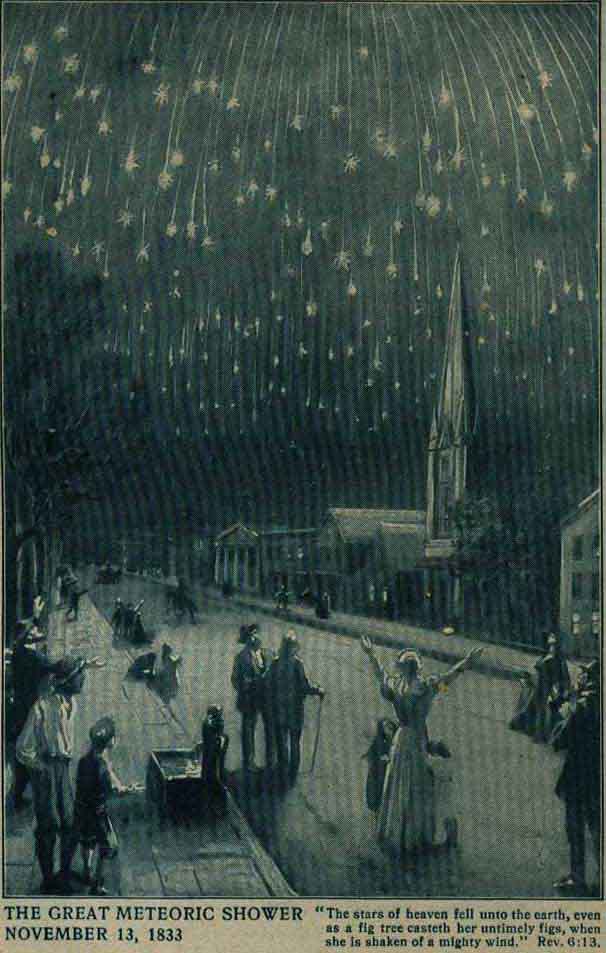 |
| (Source) |
On the night of the 12th, many sky watchers noticed that there seemed to be an unusually high number of meteors in the sky heading into the morning of the 13th. Suddenly, as if someone turned on a switch, the sky filled with meteors to the tune of, according to some estimates, over 200,000 per hour! That translates to over 3,000 per minute or, even more mind boggling, 50 meteors per second. All across North America, people were woken by their bedrooms suddenly becoming filled with light thanks to the light of all the meteors. Now, the kicker: this lasted for 4 hours until the Sun started to rise.
Other estimates are more realistic-- 14,000 per hour. The Leonids produced another spectacular shower in 1866, with 5,000 per hour visible in Europe, and 1,000 per hour visible in North America.
(44) The Lamanites will blossom as the rose. D&C 49:24. Mexico is projected to have the 5th largest economy in the world by 2050.
(45) The New Jerusalem will be built. See D&C 45:66-69. This will be in Jackson County, Missouri, near Independence.
(46) Many temples will be built.
(47) A temple will be built in Jerusalem.
(48) The gospel will flourish in Egypt and temple will be built there. Isaiah 19:18-22.
(49) The rainbow is withdrawn. Ridges recites a prophecy given by Joseph Smith that "whenever you see the [rain] bow withdrawn, it shall be a token that there shall be famine, pestilence, and great distress among the nations, and that the coming of the Messiah is not far distant." (History of the Church, 6:254). Although Ridges does not speculate as to the cause of this, I wonder if it is related to the prophecy of the sun being dimmed.
(50) The Constitution will hang by a thread. Ridges notes that the Lord established the Constitution by the hands of the Founding Fathers (D&C 101:77-80). He notes several of the prophets that have spoken of the time when the Constitution will almost be destroyed, including Ezra Taft Benson, who warned: "Unfortunately, we as a nation have apostatized in various degrees from different Constitutional principles as proclaimed by the inspired founders. We are fast approaching that moment prophesied by Joseph Smith when he said: 'Even this nation will be on the very verge of crumbling to pieces and tumbling to the ground, and when the Constitution is upon the brink of ruin, this people will be the staff upon which the nation shall lean, and they shall bear the Constitution away from the very verge of destruction.'"
(51) Destroying angels will be allowed to go forth upon the Earth (being fulfilled). This particular sign is from D&C 85:5-6, which expands on the parable of the wheat and the tares, as applied to these latter days. Those particular verses state:
(52) The "abomination of desolation" will take place again. Although this refers to the besieging of Jerusalem, Ridges considers this to be in the category of "being fulfilled." His reasoning is that Jerusalem is currently under siege today, and has been for many years. Although Ridges speaks in the sense that Israel is surrounded by its enemies, I believe that this will have a literal fulfillment--an invasion of Israel with troops surrounding and finally taking the city.
(53) Wickedness will be rampant (being fulfilled). Ridges explains:
Ridges further writes:
Some may question why we should look forward to this massive and complete destruction of the wicked. However, as Joseph Fielding Smith notes in The Signs of the Times, we are looking forward to a better world--"the earth renewed to receive its paradisiacal glory, cleansed of wickedness. For a thousand years we will have that kind of earth and there will not be any war, any turmoil, envying, lying; there will be no wickedness."
(55) A great hailstorm will destroy the crops of the Earth (not yet fulfilled). This is bluntly stated in D&C 29:16. See also Rev. 16:21. I have wondered if the "hail" referred to is literally balls of ice, or meteorites or other slag, such as the burning hail of the Exodus, particularly as this seems to occur in some connection with the great earthquake (infra.).
(56) There will be a great earthquake such as never before (not yet fulfilled). See Rev. 16:18. and Rev. 6:12. Ridges observes: "From these references, we understand that this earthquake will be unprecedented in the history of the earth since the fall of Adam." Although not mentioned by Ridges, the continents of the world are to be joined together again in a single landmass, so this earthquake may be related to that event.
(57) Waters will flow from the temple in Jerusalem and heal the Dead Sea (not yet fulfilled). Ezekiel 47:1-12. Ridges notes that this prophecy may be fulfilled when Christ sets foot on the Mount of Olives and it splits.
(58) The Battle of Armageddon (not yet fulfilled). This is the war described in Ezekiel 38 and 39, and Zechariah 11 through 14.
(59) The meeting at Adam-ondi-Ahman (not yet fulfilled). See D&C 116 and Daniel 7:9-14. "The Ancient of Days" refers to Adam. Ridges writes:
(60) Two prophets will be killed in Jerusalem (not yet fulfilled). Rev. 11. As prophets, these two men will necessarily need to be members of the First Presidency or Quorum of the Twelve Apostles.
Ridges quotes Charles W. Penrose as to this sign of the times:
(62) The sign of the coming of the Son of Man. (Not yet fulfilled). This sign is given in Matthew 24:29-31:
(63) The righteous will be taken up to meet the coming Lord. (Not yet fulfilled). This is not the rapture, as many Christians use that term. That is, this is not a case of the Lord taking the righteous believers from the Earth prior to the tribulations of the last days (which, if it was going to occur, would probably be happening right now). Rather, as Ridges notes, the righteous (which are those living a celestial quality of life already or, if the resurrected dead, qualified to enter into the Celestial Kingdom) will literally be caught up as a group to meet the Lord at the time of his coming and descend with Him to Earth as He comes to begin his reign. The sons of perdition and those living a telestial lifestyle (i.e., the wicked, or the "tares") will be burned at His coming. Although we are not sure of the mechanism, those living a terrestrial lifestyle will be preserved--these will be the subject of intense missionary efforts since, as we know, many of those without knowledge of the Gospel or of Christ will remain.
(64) The wicked will be burned. (Not yet fulfilled). Malachi 4:1 indicates:
As noted above, those that are neither among the "righteous" believers, nor among the wicked, will not be destroyed. Ridges quotes Joseph Smith:
Ridges does not address the issue of why the wicked must be destroyed. It is one of the great lies taught that a loving God would not punish and destroy some of his children. This has morphed even further into the belief that if God loves the sinner, he will also love the sin (or, at the least, be tolerant of the sin). This argument is often heard by those espousing a homosexual lifestyle or other sexual immorality--they reason that God could not be angry with two people expressing their love toward one another. The flip side of this argument is that advanced by many atheists who do not understand how a loving God could tolerate, let alone, order the Israelites to attack and destroy a city or people. Those holding these thoughts are blinded by the idea of moral equivalence--that all moral choices are equivalent, and there is no "good" and "bad" or gradations between.
That fact is, like a loving Father, God is more than willing to destroy those whose wickedness threatens the destruction of the good--just as if you had the choice of killing a murderer, or letting the murderer kill your spouse and children, you would kill the murderer. Basic humanity requires nothing less. Obviously, God allows people their free agency, and this short life is merely a test, so God does not prevent bad things from happening to people. Even the righteous suffer trials. But there are points when a line is crossed, where wickedness is so rampant, that the only way to destroy the wickedness is to destroy the wicked--to completely remove their wicked teachings and practices (i.e., memes) from the face of the earth. Such occurred with the Flood of Noah, and such will be the state prior to the Second Coming. The cancer, or infection, of wickedness will be removed, together with those that carry that disease within them.
(65) Everyone will see Christ when He comes. (Not yet fulfilled). Ridges cites Revelation 1:7, which states:
(51) Destroying angels will be allowed to go forth upon the Earth (being fulfilled). This particular sign is from D&C 85:5-6, which expands on the parable of the wheat and the tares, as applied to these latter days. Those particular verses state:
5 Behold, verily I say unto you, the angels are crying unto the Lord day and night, who are ready and waiting to be sent forth to reap down the fields;Ridges goes on to note an 1894 statement by Wilford Woodruff that these destroying angels had been loosed to commence their work. I will add the following on Pres. Woodruff's revelation concerning the matter. In Joseph Fielding Smith's The Signs of the Times, he notes that in June 1894, Pres. Woodruff stated:
6 But the Lord saith unto them, pluck not up the tares while the blade is yet tender (for verily your faith is weak), lest you destroy the wheat also.
God has held the angels of destruction for many years lest they should reap down the wheat with the tares. But I want to tell you now, those angels have left the portals of heaven, and they stand over this people and this nation now, and are hovering over the earth waiting to pour out the judgments. And from this very day they shall be poured out. ... Great changes are at our doors. The next twenty years will see mighty changes among the nations of the earth. You will live to see these things whether I do or not. I have felt oppressed with the weight of these matters, and I felt I must speak of them here. It is by the power of the Gospel we shall escape.(Signs of the Times, pp. 115-16).Pres. Smith noted that it was 20 years and 1 month later that WWI began.
(52) The "abomination of desolation" will take place again. Although this refers to the besieging of Jerusalem, Ridges considers this to be in the category of "being fulfilled." His reasoning is that Jerusalem is currently under siege today, and has been for many years. Although Ridges speaks in the sense that Israel is surrounded by its enemies, I believe that this will have a literal fulfillment--an invasion of Israel with troops surrounding and finally taking the city.
(53) Wickedness will be rampant (being fulfilled). Ridges explains:
While this sign of the times may be considered a summary of several of the signs of the times already given previously in this book, it merits being discussed as a sign in and of itself. It appears that wickedness in the last days prior to the Second Advent of Christ won't just "happen" as a matter of natural deterioration of morals and values. Rather, if we understand this prophecy correctly, it will be the direct result of wickedness spread intentionally by use of mass media, which will cause an unprecedented acceleration of evil and virtual "free fall" of society.I think of it as similar to a feed-back loop in an audio system. The media acts as an amplifier. It amplifies the wickedness, which gets broadcast, picked up again and magnified, rebroadcast, and so on, ad infinitum. Except, the system will burn out--spectacularly so.
Ridges further writes:
This intentional spread of wickedness by Lucifer and his "front organizations" is spoken of in the Bible. In the great vision given to John the Apostle ... one of the things that John was shown was that great masses of people would admire and basically worship wicked heroes in the last days. Thus, the mass "worship" of unworthy media personalities is a significant contributor to the rampant wickedness of the last days.(54) Babylon will fall (yet to be fulfilled). Ridges indicates that "Babylon" refers to Satan's kingdom--the great body of the wicked and perverse--that will be destroyed in two broad steps. First, many will be destroyed in the wars and disasters preceding the Second Coming. Second, those that survive, will be destroyed when the Lord comes to cleanse the Earth. Ridges cites to Rev. 19:17-21 and D&C 29:21.
Some may question why we should look forward to this massive and complete destruction of the wicked. However, as Joseph Fielding Smith notes in The Signs of the Times, we are looking forward to a better world--"the earth renewed to receive its paradisiacal glory, cleansed of wickedness. For a thousand years we will have that kind of earth and there will not be any war, any turmoil, envying, lying; there will be no wickedness."
(55) A great hailstorm will destroy the crops of the Earth (not yet fulfilled). This is bluntly stated in D&C 29:16. See also Rev. 16:21. I have wondered if the "hail" referred to is literally balls of ice, or meteorites or other slag, such as the burning hail of the Exodus, particularly as this seems to occur in some connection with the great earthquake (infra.).
(56) There will be a great earthquake such as never before (not yet fulfilled). See Rev. 16:18. and Rev. 6:12. Ridges observes: "From these references, we understand that this earthquake will be unprecedented in the history of the earth since the fall of Adam." Although not mentioned by Ridges, the continents of the world are to be joined together again in a single landmass, so this earthquake may be related to that event.
(57) Waters will flow from the temple in Jerusalem and heal the Dead Sea (not yet fulfilled). Ezekiel 47:1-12. Ridges notes that this prophecy may be fulfilled when Christ sets foot on the Mount of Olives and it splits.
(58) The Battle of Armageddon (not yet fulfilled). This is the war described in Ezekiel 38 and 39, and Zechariah 11 through 14.
(59) The meeting at Adam-ondi-Ahman (not yet fulfilled). See D&C 116 and Daniel 7:9-14. "The Ancient of Days" refers to Adam. Ridges writes:
We learn from the above quote [from Daniel] that the meeting at Adam-ondi-Ahman, before the actual Second Coming, will be a rather large gathering, where Adam will gather his righteous posterity together. Christ will come also, and those present, who are or have been in authority, will turn their keys of power over to Him to use as He ushers in the Millennius and governs the world during the Millennium....This meeting will be secret from the world at large.
(60) Two prophets will be killed in Jerusalem (not yet fulfilled). Rev. 11. As prophets, these two men will necessarily need to be members of the First Presidency or Quorum of the Twelve Apostles.
(61) The Mount of Olives will split in two. (Yet to be fulfilled). The basic source for this sign is Zechariah 14:1-5, which reads:
1 Behold, the day of the Lord cometh, and thy spoil shall be divided in the midst of thee.This may very well be the earthquake that accompanies the Lord's return, as D&C 45:48 indicates:
2 For I will gather all nations against Jerusalem to battle; and the city shall be taken, and the houses rifled, and the women ravished; and half of the city shall go forth into captivity, and the residue of the people shall not be cut off from the city.
3 Then shall the Lord go forth, and fight against those nations, as when he fought in the day of battle.
4 ¶And his feet shall stand in that day upon the mount of Olives, which is before Jerusalem on the east, and the mount of Olives shall cleave in the midst thereof toward the east and toward the west, and there shall be a very great valley; and half of the mountain shall remove toward the north, and half of it toward the south.
5 And ye shall flee to the valley of the mountains; for the valley of the mountains shall reach unto Azal: yea, ye shall flee, like as ye fled from before the earthquake in the days of Uzziah king of Judah: and the Lord my God shall come, and all the saints with thee.
And then shall the Lord set his foot upon this amount, and it shall cleave in twain, and the earth shall tremble, and reel to and fro, and the heavens also shall shake.That is, this may be The Earthquake when the whole Earth will tremble and shake, the "stars" fall, and the continents be gathered together into one.
Ridges quotes Charles W. Penrose as to this sign of the times:
His [Christ's] next appearance [after his appearance in the New Jerusalem] will be among the distressed and nearly vanquished sons of Judah. At the crises of their fate, when the hostile troops of several nations are ravaging the city and all the horrors of war are overwhelming the people of Jerusalem [ed: i.e., the abomination of desolation], he will set his feet upon the the Mount of Olives, which will cleave and part asunder at his touch. Attended by a host from heaven [ed., perhaps the 144,000], he will overthrow and destroy the combined armies of the Gentiles, and appear to the worshiping Jews as the mighty Deliverer and Conqueror so long expected by their race; and while love, gratitude, awe, and admiration swell their bosoms, the Deliverer will show them the tokens of his crucifixion and disclose himself as Jesus of Nazareth, whom they [ed. i.e., their ancestors] had reviled and whom their fathers put to death. Then will unbelief depart from their souls, and "the blindness in part which has happened unto Israel" be removed.(Italicized brackets in original; others are mine).
(62) The sign of the coming of the Son of Man. (Not yet fulfilled). This sign is given in Matthew 24:29-31:
29 ¶Immediately after the tribulation of those days shall the sun be darkened, and the moon shall not give her light, and the stars shall fall from heaven, and the powers of the heavens shall be shaken:
30 And then shall appear the sign of the Son of man in heaven: and then shall all the tribes of the earth mourn, and they shall see the Son of man coming in the clouds of heaven with power and great glory.
31 And he shall send his angels with a great sound of a trumpet, and they shall gather together his elect from the four winds, from one end of heaven to the other.Ridges goes on to cite some other references and quotes regarding this sign, but the important point is that no one knows what is this sign--no description of it is given. We merely know that it follows many of the other signs--wars and rumors of wars, the sun turned into darkness and the moon to blood, earthquakes and diverse places, and so on. Ridges quotes Joseph Smith as stating that the people of world will attempt to put this sign off as a natural phenomena, such as a planet or comet. I believe that the righteous shall understand this sign, and it will strengthen them; and the those wicked who understand the end times (the sons of perdition) shall also understand, and it will strike fear into their hearts. But for the rest of humanity, it will be just another of bewildering disasters and inscrutable portents.
(63) The righteous will be taken up to meet the coming Lord. (Not yet fulfilled). This is not the rapture, as many Christians use that term. That is, this is not a case of the Lord taking the righteous believers from the Earth prior to the tribulations of the last days (which, if it was going to occur, would probably be happening right now). Rather, as Ridges notes, the righteous (which are those living a celestial quality of life already or, if the resurrected dead, qualified to enter into the Celestial Kingdom) will literally be caught up as a group to meet the Lord at the time of his coming and descend with Him to Earth as He comes to begin his reign. The sons of perdition and those living a telestial lifestyle (i.e., the wicked, or the "tares") will be burned at His coming. Although we are not sure of the mechanism, those living a terrestrial lifestyle will be preserved--these will be the subject of intense missionary efforts since, as we know, many of those without knowledge of the Gospel or of Christ will remain.
(64) The wicked will be burned. (Not yet fulfilled). Malachi 4:1 indicates:
For, behold, the day cometh, that shall burn as an oven; and all the proud, yea, and all that do wickedly, shall be stubble: and the day that cometh shall burn them up, saith the Lord of hosts, that it shall leave them neither root nor branch.This, of course, is the point of the well-known scriptural references to the gathering of the wheat and the burning of the tares. Ridges focuses on the mechanism of the burning, noting that the scriptures indicate "that the wicked will be burned by the glory of the coming Lord. Since they are not worthy to be 'quickened' or transfigured with the righteous, they will be consumed by the glory of the resurrected and glorified Christ." (See, e.g., 2 Thessalonians 2:8). Ridges adds: "Since this will be a selective destruction, only those people and those things that do not belong on earth during the Millennium will be destroyed."
As noted above, those that are neither among the "righteous" believers, nor among the wicked, will not be destroyed. Ridges quotes Joseph Smith:
There will be millions of people, Catholics, Protestants, agnostics, Mohammedans, people of all classes and all beliefs, still permitted to remain upon the face of the earth, but they will be those who have lived clean lives, those who have been free from wickedness and corruption. All who belong, by virtue of their good lives, to [at least] the terrestrial order, ... will remain upon the face of the earth during the millennium.(Brackets and ellipses in original).
Ridges does not address the issue of why the wicked must be destroyed. It is one of the great lies taught that a loving God would not punish and destroy some of his children. This has morphed even further into the belief that if God loves the sinner, he will also love the sin (or, at the least, be tolerant of the sin). This argument is often heard by those espousing a homosexual lifestyle or other sexual immorality--they reason that God could not be angry with two people expressing their love toward one another. The flip side of this argument is that advanced by many atheists who do not understand how a loving God could tolerate, let alone, order the Israelites to attack and destroy a city or people. Those holding these thoughts are blinded by the idea of moral equivalence--that all moral choices are equivalent, and there is no "good" and "bad" or gradations between.
That fact is, like a loving Father, God is more than willing to destroy those whose wickedness threatens the destruction of the good--just as if you had the choice of killing a murderer, or letting the murderer kill your spouse and children, you would kill the murderer. Basic humanity requires nothing less. Obviously, God allows people their free agency, and this short life is merely a test, so God does not prevent bad things from happening to people. Even the righteous suffer trials. But there are points when a line is crossed, where wickedness is so rampant, that the only way to destroy the wickedness is to destroy the wicked--to completely remove their wicked teachings and practices (i.e., memes) from the face of the earth. Such occurred with the Flood of Noah, and such will be the state prior to the Second Coming. The cancer, or infection, of wickedness will be removed, together with those that carry that disease within them.
(65) Everyone will see Christ when He comes. (Not yet fulfilled). Ridges cites Revelation 1:7, which states:
Behold, he cometh with clouds; and every eye shall see him, and they also which pierced him: and all kindreds of the earth shall wail because of him. Even so, Amen.Ridges emphasizes that, for the righteous, this event will be a time of great joy and peace; but for the wicked, it will be a time of great dread. (See, e.g., Isaiah 11:6-9; compare with Rev. 6:14-16).
Subscribe to:
Posts (Atom)