VIDEO: "Bombs & Bants" (52 min.)
Covering a lot of current event topics including the trucker strike in Canada and the Left's growing unease over the Right co-opting the Left's tactics.
I came across a Daily Mail article today that recounted the experience of novice Iditarod musher whose dog team was attacked by a moose while they were out practicing. She tried to scare it off, but as it continued to stomp on some of her dogs, she finally resorted to her pistol, which she emptied into the moose with no effect. Eventually a friend arrived on scene with a rifle and killed the moose with one shot.
I don't know what make or model of pistol she had, but she described it as a .380! I'm sure in her naivety she was thinking more of minimizing the weight and bulk of the firearm rather than its effectiveness. She also only intended for the firearm to deter or scare off an animal. Fortunately, none of the dogs were seriously injured. The article does report, though, that "She has since upgraded to a larger caliber firearm after [the .380] didn't stop the moose."
The sad part is that the .380 didn't even injure the moose enough to make it angry (or angrier). So, the lesson from this is that although the .380 may be acceptable for self-defense against two-legged critters, you should not expect a 1-shot (or 7 or 8-shot) drop when hunting moose.
The YouTube Channel "Modern Tactical Shooter" recently released a video on what the presenter called the "Near Far Drill." Basically, the drill uses 4 targets, two of which are closer together as well as closer to the shooter. The other two are set slightly farther back and spaced apart far enough so that they are obscured from the shooter's view unless the shooter moves farther left or right, respectively. It seems a good drill to introduce you to movement to acquire a target, and it is a timed drill so there is a bit of pressure/stress on the shooter.
The video demonstrating the drill is below. If you like something that you can print out, the author has copies of this drill (and others) that you can save and print later on his Facebook page.
I've just barely finished a couple books on the collapse of Roman/Classical Civilization in the early 7th Century AD following the violent spread of Islam throughout the Near East and most of the the lands bordering the Mediterranean Sea. The Islamic invasion and predations caused a three century "dark age" throughout Europe, North Africa, and the Near and Middle East where there is virtually no activities that left archeological evidence (this is has inspired a theory that the 7th, 8th, and 9th Centuries were "made up" and never occurred). This dark age was not just physical destruction of communities and trade, but also a destruction of books and libraries, and the end of trade in papyrus that was used as "paper" at that time throughout Europe and other Mediterranean areas. As much as anything else, this resulted in the loss of the Roman/Classical Civilization with its widespread literacy and helped usher in the period of feudalism.

It must be presumed that any disaster sufficient to destroy or seriously disrupt civilization could result in a similar loss of libraries and centers of learning on a national level, and certainly disruption of elementary and secondary education at the local and state level. Yet I have only seen at most one or two books on prepping that have discussed preparing to educate your children and to set aside books that important to preserving our culture. I believe it was Alexis de Tocqueville who related that in the early American Republic there was not to be found a home, high or low, that did not have a Bible, something written by Shakespeare, and a newspaper or similar. And, in fact, the shared love of Shakespeare by both the "masses" and the "elites" was a feature of American civilization until the flood of foreign migration in the post-Civil War era.
We are not in so dire a predicament of losing our civilizational knowledge today. Libraries, both great and small, are widespread across the continent; and the average person can likewise afford personal libraries greater than all but the wealthiest individuals could afford in prior centuries. If electronic devices can be preserved, then a person can easily put together a collection of books ranging from kindergarten level to college and professional texts and treatises, reference books related to the trades, engineering, medicine, manufacturing, etc.
But educating future generations is more than just assembling a bunch of how-to books. Even the Arab invaders of the 7th Century saw the value in keeping alive knowledge concerning science, medicine, and other technical subjects. What they destroyed were the religious, philosophical, and cultural and literary works of the ages. For instance, although parts of the collection of the Library of Alexandria had been victim to fires, mobs, and armies before, the Library met its final end on the orders of the Second Muslim Caliph, Umar ibn al-Khattab (634 – 644 AD). Although some historians consider the account apocryphal, an early account of the destruction related (footnotes omitted; brackets in original):
"We are told that the Arab emir, ‘Amr ibn al-‘Āṣ, consulted ibn al-Khattab on what to do with the books in the Library of Alexandria. Ibn al-Khattab’s answer came quick to him:
“As for the books you mention, if there is in it what complies with the Book of God [Q’uran], then it is already there and is not needed and if what is in these books contradict the Book of God there is no need for it. And you can then proceed in destroying them.”
‘Amr ibn al-‘Āṣ then ordered that the books should be dispersed in the public baths and to burn them in the bath’s heaters. Al-Qifti adds: “And I was told that at that time several public baths used [the books] for heating, bringing some fame to new public baths which later on were forgotten afterwards and it is said that they had enough heating for six months. One who listens to what has happened can only be amazed!”
So, with the importance of preserving cultural and literary works in mind, I was pleasantly surprised to come across a web-site called Planet Ebook that has a collection of what are generally considered some of the great cultural and literary works of Western Civilization (at least, those that are no longer under copyright). Books by Mark Twain, James Joyce, Nicolo Machiavelli, Jane Austin, Charles Dickens, and more. Each book, moreover, is available in PDF, epub, and mobi formats so you can be sure to get one that is compatible with one of your electronic book readers. And, of course, I have listed other resources for locating books in my ebook resource page.
Another source I came across recently was a site called The Creative Archive that has collected together ebook versions of the classic Hardy Boys, Nancy Drew, and Three Investigator books. The books are offered in PDF, but they don't have page numbering, header or footers, so they should easily be converted to epub and mobi files. I know these are not classics of American literature but they do inculcate many Western values through fun and interesting stories for tweens and early teens.
Jon Low came across what appears to Marcus' obituary (link here) posted by the funeral home. You can sign the guest book and there is provision for making a donation to the family.
Peter Grant, over at Bayou Renaissance Man, has an interesting article on the topic of "Renewed interest in the 10mm Auto as an optimum defensive round." He has a good look at the current and probable future of the evolving criminal threats that private citizens face, and I suggest that you read his article before continuing with my post. I only fault him in one regard: he expresses a common misconception about energy and bullet effectiveness in discussing why the 10mm may be an optimal defensive round.
Before I delve into Grant's article, just a little history on the 10mm as a defensive cartridge. After the 1986 FBI shootout in Miami which resulted in two agents being killed and five injured, the FBI drew the lesson that bullet penetration was suboptimal with the firearms it used and so it created standards still used to this day to judge the effectiveness of bullets. These standards drive bullet design to this day, mixing penetration against various materials as well as both maximum and minimum penetration in ballistic gelatin.
Because bullet technology was not what it was today, the FBI's quest for a better duty weapon necessarily resulted in it turning to a more powerful round that would be able to ensure both expansion and penetration. That initially was the 10mm, but when the 10mm was found to have too much recoil for its agents, the FBI necessarily started using a down-loaded round; which, in turn, prompted Smith & Wesson to develop the 40 S&W which is, essentially, a shortened 10mm.
For purposes of my discussion, the key part of the FBI standard is that when shot into ballistic gelatin, penetration was to be no more than 18-inches in order to avoid over penetration--the bullet passing completely through a person. Consequently, hollow-point bullets for police duty use or civilian defense are engineered to open up (mushroom) which acts similar to a drag chute and slows the bullet limiting its penetration. (It also creates a larger wound channel).
So, with that in mind, and turning to Grant's article, he makes the common mistake of equating handgun "power" with effectiveness. He writes concerning the 10mm:
There are those who'll argue that more accurate shot placement would allow the smaller round to perform just as well as a larger one. That's fine in theory, but when you've got a moving target (the perpetrator) closing on you rapidly, possibly with a weapon in his hand, and you're moving to avoid his attack, and your stress and adrenaline levels are off the charts . . . it's a whole world away from shooting slowly, calmly and without stress on the square range at paper targets that don't move and aren't threatening you. Some (very few) shooters can perform as well under such extreme stress as they do during training. Most of us can't. We should expect to be less accurate - which places more of a burden on the rounds we're shooting to do the best job they can when they hit whatever they hit.
I know many shooters blindly trust the "official" figures, charts and data, which claim that a quality 9mm hollowpoint will deliver as much expansion, penetration and energy as a bigger round. They're right, on paper. However, real life doesn't take place on paper, and drug-addled criminals can and will make a mockery of what "the book" says should happen when they're shot. I discussed this issue in an article some years ago:
Bullet and cartridge effectiveness for self-defense
If you didn't read that article at the time, I strongly suggest that you click over there and read it now. In particular, read the whole thing, not just the beginning. There's a lot of "meat" in there, and it's all important. In brief, size (projectile cross-section, bullet weight and overall expansion potential) does matter; and bigger bores have benefited from the same technological advances that have improved the 9mm. They've all gotten better than they were.
In brief, due to the possible need to repel multiple assailants, cartridge capacity is important. While the 9mm is champion in that regard right now, the 10mm (and its smaller cousin, the .40 S&W) is pretty close on its heels, and all of them usually outperform the venerable .45 ACP. (For example, comparing full-size models, the 9mm Glock 17 holds 17+1 rounds; the 10mm Glock 20 and the .40 S&W Glock 22 both hold 15+1 ; and the .45 ACP Glock 21 holds 13+1.)
On the other hand, there's the need to hit a potentially hopped-up assailant as hard as possible, to make him cease his attack on you. The 9mm is no slouch, but it hits less hard than the .40 or .45 - and the 10mm outperforms all of them, if a full-power round is used.
To understand why the Power = Deadliness equation is not accurate you must remember that, absent the bullet striking and destroying something essential like the heart or the brain, incapacitation of a living target is due to shock either due to hydrostatic shock or the loss of blood, itself largely dependent on the size of the wound channel (both diameter and depth). Unfortunately, no single factor--bullet mass, velocity, energy, momentum, cross section density, bore diameter--can tell you how effective a bullet will be at putting down a living target.
Because of the properties of the water in living tissue, hydrostatic shock is largely a function of velocity. Turning to Ballistic Studies, a great source of information on terminal ballistics on game animals, it notes that "[h]ydrostatic shock, in bore sizes from .243” up to .338”, begins to lesson at impact velocities below 2600fps and most modern high velocity sporting cartridges including the magnums gradually lose shocking power beyond 300 to 350 yards," although with larger calibers, "hydrostatic shock can occur on our medium game species at velocities as low as 2200fps." (Interestingly, the effects of hydrostatic shock can also decline if the velocity is over 3150 fps).
Like most every cartridge, the muzzle velocity of 10mm is well below even 2200 fps. Ballistics 101 has compiled the muzzle velocity of numerous commercial loads of 10mm. You will note that the typical muzzle velocities of the most widely distributed commercial ammunition is between 1000 and 1250 fps. Some of the more boutique manufacturers like Buffalo Bore, Cor Bon, Double Tap, etc., offer selections with muzzle velocities in excess of 1400 fps with one as high as 1600 fps. Even these are still well below the minimum necessary for producing hydrostatic shock. And, I would add, largely within the same velocity ranges as 9mm loadings.
So we are left with the size of the wound channel, which as I noted is going to be a mix of the depth and width of the wound channel. Lucky Gunner has tested the 10mm in ballistic gelatin, and you can see the results here. Per FBI protocol, you can see that most of the defensive ammunition remained in the 12 to 18 inch penetration depth, with the bullets expansion in the range of .61 inches up to .81 inches. Compared with 9mm, the penetration for defensive ammunition is about the same, but as you expect from a smaller bullet, the expanded diameters are slightly smaller overall. Nevertheless, the newer and better quality defensive rounds such as HST and HST +P loads were up in the same range of expanded diameter.
So, even though 10mm is more "powerful" than 9mm, at least when looking at kinetic energy, the tests do not show that the 10mm is going appreciably more effective than the 9mm when using common police duty or civilian defensive loads. This is better illustrated by comparing the 9mm versus the .357 Sig which, notwithstanding its name, still uses the same .355 diameter bullets as the 9mm. The .357 Sig uses a larger case than the 9mm, but necked down to accept the .355 bullet. The purpose was to provide greater powder capacity and, therefore, greater energy--in other words, a more powerful round. But due to the constraints of the FBI protocol to avoid overpenetration, it doesn't actually appear to be more effective than 9mm in either tests or on the street. Chris Baker of Lucky Gunner actually discusses this in a video and article entitled ".357 Sig: What’s the Point of this Cartridge?" He relates, in part:
Any time we test a new caliber, I like to do some background research on it. So a couple of weeks ago, I was reading an article published back in the Fall of 2000 by Dr. Gary Roberts, who is probably the most well-known wound ballistics researcher active today. He was sharing the results of a .357 Sig gelatin test he performed at the California Highway Patrol Academy range. This was printed in the Wound Ballistics Review, which was a scientific journal intended for hardcore ballistics nerds, so it tends to be pretty dry and technical most of the time. But at the end of this one article, Dr. Roberts breaks into editorial mode and he says,
“Compared to a 9mm, the .357 Sig has a decreased magazine capacity, more recoil, as well as greater muzzle blast and flash, yet at best it offers no gain in bullet penetration and expansion characteristics. What is the point of this cartridge?”
The 10mm offers slightly larger expansion--but still less than .1 inches--and the depth of the wound channel is pretty much the same. But if you were to compare the 10mm versus the .40 S&W, you would again be asking what is the point of the 10mm over the .40 S&W.
The reason the 10mm started seeing a resurgence was not because of defensive reasons, but in the realm of hunting and defense against wild predators. In that case, the bullet designs are not limited due to overpenetration. In fact, against a large animal such as a bear, the heavy hide, bones, and dense muscle mass calls for something with good penetration. This is where the 10mm really shines over lesser cartridges like the 9mm, .40 S&W, or even standard .45 ACP, because instead of all that extra energy being wasted, it will be converted to work: i.e., driving the bullet deeply into the body of the target.
Now, I will note that my discussion falls into the realm of "on paper" or "in theory" that Grant complains isn't a substitute for experience on the street, and he cites an officer that carries a 10mm as a backup to his duty 9mm, and uses the 10mm as his primary against drug crazed offenders. I can't speak to what the actual on the street statistics would show--I don't have that data. But I would note the following from Greg Ellifritz's study on the effectiveness of cartridges:
Something else to look at here is the question of how fast can the rounds be fired out of each gun. The .38 SPL probably has the slowest rate of fire (long double action revolver trigger pulls and stout recoil in small revolvers) and the fewest rounds fired to get an incapacitation (1.87). Conversely the 9mm can probably be fired fastest of the common calibers and it had the most rounds fired to get an incapacitation (2.45). The .40 (2.36) and the .45 (2.08) split the difference. It is my personal belief that there really isn't much difference between each of these calibers. It is only the fact that some guns can be fired faster than others that causes the perceived difference in stopping power. If a person takes an average of 5 seconds to stop after being hit, the defender who shoots a lighter recoiling gun can get more hits in that time period. It could be that fewer rounds would have stopped the attacker (given enough time) but the ability to fire more quickly resulted in more hits being put onto the attacker. It may not have anything to do with the stopping power of the round.
So, a 10mm may seem better to the cop on the street at stopping someone because it took less shots, but that in turn might only be because of the 10mm having such recoil that the officer was not able to shoot as fast with the 9mm giving the appearance of the 10mm being more effective because of the lower round count.
That does leave us with the question of what about the extra energy had by the 10mm? Is it just wasted, turning to heat rather than work? In soft tissue, I would say yes. But although I don't have the results of penetration tests against barriers, some of the testing I've seen in YouTube videos does seem to show that the 10mm is better for breaking down hard barriers such as cinder blocks and, perhaps, by extension, bone.

Only knowing Marcus for such a short time, and only communicating through email, I can't say that I knew Marcus as well as did many others in the shooting community. But there were several things I learned of the man that came through in his comments and emails.
First, he was a deeply spiritual man. He had an intense interest in religious and spiritual beliefs of various sects and peoples, which often showed up in his writing. He had an intense faith in God and was eager to understand His word.
Second, he really cared about people. His life seemed to have been one concentrated on protecting the good from the evil. Although I don't know much of his life as a trainer, I know that he helped train anti-terrorist police and military units in such diverse places as South Africa, Israel, and Northern Europe, as well as in the United States. In his emails to me, he had a great deal of concern on where society was going and the consequences it could have on people. On an individual level, he helped train people in self-defense techniques and did other work to help people win the good fight against the evil in this world.
On a personal note, he and I shared an interest in the Suspicious Observers You Tube channel and the information provided there. He also went out of his way to help me with my blog. He would include me in emails he sent out with interesting news stories, articles or videos related to self-defense, and terrorist warnings that had been issued, many of which I passed on to you, the readers of this blog. He helped my blog in other ways such as putting me in touch with people that could provide gear for me to review, as well as answering questions I had as to certain topics or volunteering information about topics I had raised in my blog. For instance, after I posted a recent video about "woobies" he wrote to me:
Woobies are great albeit expensive; poncho liners go back to my era in the 70s (I had a chance to handle a special prototype made as casualty blankets for the Son Tay raiders who made off with all of them when the raid came up dry). The USMC liner is well made and cheap, Skumberjak and others make good ones, but hands down FAVORITE is the Hill People Gear Mountain Serape. Brilliant design fits inside of a standard
Poncho but with carefully placed zippers turns into a great coat essentially a sleeping bag you can walk and shoot in, and also converts to a lightweight sleeping bag. Used with additional warm layers it’s entirely fine for overnights into fall and would serve in an emergency in winter if augmented by other layers and a fire. ...
Although he did not share this with me, I suspect that he directed many others to my blog.
Third, he was an accomplished writer, as attested by his novels and other works available on Amazon.
I will miss him. Until we meet again before the throne of God....
Firearms/Shooting/Self-Defense:
In order to perform this small bit of magic, Holosun had to make certain compromises. The first was to eliminate a removable battery entirely. The SCS has an onboard rechargeable battery that is charged by the solar panel. According to Holosun the SCS will have a 20k hour battery life. If the battery needs to be replaced you can send it back to Holosun.
Prepping/Survival:
Last week our power went down without warning. I was working at home as usual when the radio went off and security alarms around the neighbourhood started shrieking. After the WiFi dropped I finally took notice.Power cuts happen infrequently where I live, the power usually comes back on within an hour and life resumes. But last week was different. The previous day I’d started listening to the audiobook ‘Lights Out: A Cyberattack, a Nation Unprepared, Surviving the Aftermath’ by former ABC news anchor, Ted Koppel, and the outage found me in a twitchy mood.For a few moments my imagination ran away with me. I wondered if it was down to something innocuous (as usual) or whether instead there’d been a catastrophic cyber attack on our nation’s power grid.Within three hours the electricity came back on. It had been due to the failing of a high-voltage line which had taken out power to 3,000 homes in the area.But it could have been hackers. Really it could.
After some justification for why we are all preppers (at least those of us that try and plan for the future), the author continues:
I’ve come to believe that preparing for the unforeseen isn’t just a choice, but a responsibility. It’s one that I’ll be taking more seriously in future.
Having lived through the global pandemic that dominated 2020, is it really possible, sensible or defensible to rely on life proceeding as it always has done?
I couldn’t have foreseen a world where I’d routinely wear a face mask into a supermarket or where I’d have doubted being able to pick up basic groceries and toilet paper when I got there. 2020 showed that such things can quickly become the norm without warning.
Those living in parts of the USA that experienced gasoline shortages after the Colonial Pipeline hack would have been unlikely to have foreseen such an event — but it happened nonetheless.
Is it really such a leap to contemplate that large-scale cyber attacks or other acts of terrorism, insurrection or war could threaten and disrupt supply chains and national infrastructure? It’s happened before — frequently.
Read the whole thing.
... I started at the book really looking at the whole scene of doomsday preppers, of people who are digging bunkers and stockpiling tinned goods, and talking about the imminence of the End Times. And it's an international movement, there are a lot of preppers in Ireland and in Britain and across Europe, but really, the most kind of fervent and intense stuff tends to come, unsurprisingly, out of the U.S. And there's a couple of reasons for that.One of which is that America seems, to me, to be a country with a particularly kind of intense relationship historically and culturally with the apocalypse. The United States, as a colonial enterprise, was born out of a moment of apocalyptic fervor in Europe, with the Pilgrims, and so on. And there's something about the prepper movement that sort of recapitulates that sense of fervor of the first European colonizers of America and the Pilgrims, and so on.When preppers talk about the collapse of civilization, they're often talking about a situation where there's no more government, where you can't rely on ‘society,’ you can't rely on your fellow people. And it's just you, the kind of rugged individual, pitting yourself against the wilderness or other people, savage people, and so on. And there's a sense of a return to some of the darker mythologies at the heart of that moment in American history with the prepper movement, I think.”
I would counter that when you live in a country of over 300 million people, with a land area almost as big as Europe, it is easy to realize that it is impossible for the government to do anything for you in the event of a national (or larger) emergency. Besides, unlike much of Europe, several large regions of the United States are at risk from earthquakes, others are at risk of hurricanes, and the United States has more tornadoes than the rest of the planet.
Deadly pandemics, fuel shortages and the breakdown of vital supply chains were once the stuff of disaster movies.But, while we’re getting used to panic-buying toilet rolls and petrol after Covid and Brexit, some savvy Brits were ready years before.Preppers – those who “prepare” for natural disasters and other emergencies by learning survival skills and stocking up on food and equipment – have long been dismissed as paranoid extremists.For most, it conjures up images of isolated, heavily armed groups such as the Fortitude Ranch, deep in the woods of West Virginia, US, ready to retreat to their bunker and fend off all those who come near.But the movement – in a much more modest form – has been quietly growing in the UK too.Survival psychologist Dr Sarita Robinson, 46, began prepping after moving from Lancashire to California’s San Andreas fault earthquake zone in the early 2000s to work on her PhD.She says: “I was writing about earthquake survivors and preppers. What became clear was that those who prepped were better at surviving.“I realised I was living in quite a hazardous area and maybe I should have a quake survival kit.”
Not so "crazy" when the state and local governments are advising you to have food, water, and other supplies stashed away.
To begin preparing for a disaster, Ramey urges any prospective preppers to "ignore the extreme stuff like nuclear bunkers" and start small, focusing on what their biggest risks are, which for most people, he says, is personal health and finances."Once those bases are covered, such as an emergency fund with three months worth of expenses, you must look to ensure you're able to survive in your home without any outside utilities or help for at least two weeks."From there, Ramey suggests building a "bug-out bag" - a bag packed with survival supplies such as food, water, medications, radios, and flashlights - in the event of an emergency that requires rapid evacuation.Ramey says all responsible members of society should begin prepping in some capacity, likening preparing for an emergency to buying homeowner's insurance or car insurance.
Even if your personal health and finances are not in order, you can set aside a three (or four) day supply of food and water that can be stored without refrigeration and can be eaten with no or minimal preparation in the event of a disaster. I would note that the idea of a bug-out-bag (BOB) is rooted in the concept of a "go bag" and a 72-hour kit. 72-hour kits can be purchased ready made, of course, but there are plenty of government, NGO, and private sources on how to assemble a 72-hour kit or checklists for what to include. See, e.g., the suggestions from Ready.gov, Be Ready Utah, Healdsburg CA, University of Houston-Victoria, the Maryland Municipal League, and NationalTerrorAlert.com.
Hunga Tonga-Hunga Ha'apai, an underwater volcano in the South Pacific, spewed debris as high as 25 miles into the atmosphere when it erupted on January 15.
It triggered a 7.4 magnitude earthquake, sending tsunami waves crashing into the island, leaving it covered in ash and cut off from outside help.
Some other news stories related to the eruption, earthquake and/or tsunami that struck Tonga:
News & Current Events:
Both are also charged for a booklet Rasanen wrote and Pohjola published in 2004. Pohjola told The Federalist in an exclusive in-person interview in November 2021 that he asked Rasanen to write the booklet because she was qualified, as a medical doctor and the wife of a pastor. That booklet affirms the classic understanding of sex as reserved solely for marriage, and marriage as comprising one man committed to one woman for life.
In spring 2019, the two were suddenly served with criminal charges for writing and publishing this booklet decades ago, well before Finland passed its hate crimes laws on behalf of powerful special interests who dispute the differences between the sexes and their role in procreation. Rasanen and Pohjola have been summoned several times by Finnish police to be interrogated separately for hours about intricate details of their theology.
In their interrogations, the police demanded that Rasanen and Pohjola recant their beliefs. Both refused. Both have also noted the contrast between their country’s claim to be a free and modern democracy that allows for full and open debate and the way they have been treated, as thought criminals.
What all of this suggests, especially in the complete absence of any confirmed evidence of a “mass grave” or a coverup, is that the whole story is a giant fiction. Its purpose was to provoke a moral panic, demonize the Catholic Church, and make global headlines by peddling historical grievances. And it worked exactly as planned.But understand this: seven months on from this manufactured moral panic, there will be no backtracking from the media, no following up about the hundreds of corpses “discovered” in a “mass grave.” There will be no questions asked, and no demands for evidence.Ian Austen of The New York Times, for example, who back in May wrote about the nonexistent “evidence” of a “mass grave containing the remains of 215 children,” has not followed up on his reporting. The closest he came was in October, when he wrote a story about Pope Francis expressing a willingness to visit Canada for “indigenous reconciliation,” and repeated his earlier claim that, “the remains of hundreds of Indigenous children were found on the site of the former Kamloops Indian Residential School in British Columbia.”No, they weren’t. Nothing has been found there, because no one has looked. Probably no one ever will.
Chinese mothers gave birth to 10.62 million babies last year, an 11.5 per cent drop from 12 million in 2020, the NBS confirmed. The national birth rate fell to a record low of 7.52 births for every 1,000 people in 2021, from 8.52 in 2020.The national death rate was 7.18 per thousand last year, putting the national growth rate at 0.34 per thousand.
For years, significant and continuing losses have undermined every effort aimed at lasting economic and social development. The neighboring Balkans risk becoming a "desert" due to unemployment and, above all, emigration, especially of the young. This scenario emerges from different pieces of a complex puzzle being put together in recent weeks. These pieces include the fundamental one posed by the census in Bulgaria, which has certified an 11% drop in population over the last ten years. Another census, the one in neighboring North Macedonia, the first to be conducted in the country since 2002, confirmed that the problem is widespread, with provisional results that have worried the authorities in Skopje. According to the first data processed by the National Statistical Office, Macedonia would now have about 1.8 m inhabitants, about 10% less than twenty years ago, with 600,000 Macedonians now living abroad. Perhaps even lower than the real ones, these numbers speak of a demographic catastrophe. Those who leave the country are predominantly young people, whereas the cradles remain empty at home, and the number of older people is growing. And Macedonia is far from being an exception. Even in neighboring Romania, which is already a member of the EU, the consequences due to migration to more prosperous countries now appear uncontrollable.
Analysis & Commentary:
The research in Sullivan’s book is impressive and convincing. But the subtitle of the book, “A Cold Case Investigation,” is misleading, for the case may never have been that cold.
Early on, the book makes apparent that some people knew the identity of the person who betrayed Frank’s family to the Nazis. There is a strong possibility that Frank’s own father, Otto, the only family member to have survived the Holocaust, knew.
One is even given a rough chronology as to when he gained this knowledge. As shown by Sullivan and the research team, Otto went from feverish cooperation with the official police investigation in 1948 to indifference by the time the next official investigation in 1963 was conducted.
Otto may have supplied the reason when he told journalist Friso Endt that the family’s betrayer was Jewish. One could gather from this that either Otto was trying to protect a fellow Jew and keep what happened to his family focused on the Nazis or that he knew and forgave the betrayer because the latter faced the monstrous decision of protecting his own family by giving up others.
The most remarkable piece of evidence unearthed for the first time by the researchers was their discovery of an anonymous typed copy of a note sent to Frank’s father identifying the betrayer as a Jewish notary named Arnold van den Bergh. Miep Gies, who helped get the Frank family into the secret room in 1942, may have known about Van den Bergh as well when she hinted during a 1994 lecture that the betrayer was Jewish.
One of the most miserable groups of American workers is women, who face a “burnout crisis” and report the highest levels of workplace exhaustion and dissatisfaction. A 2021 study by McKinsey & Co. and LeanIn.Org (ironic) found that 42% of women say they feel burned out often or almost always. According to the same study, 1 in 3 women says they have considered downshifting their careers or leaving the workforce this year.
Paradoxically, women in this country were promised that we would finally be fulfilled and empowered if we entered the workforce. Unlike my mother and grandmother’s generation, who were raised to become mothers and wives, my entire generation was taught that our careers will give us deep meaning and allow us to make a difference in the world. That promise rings hollow for several reasons. On a personal level, it creates a mentality in which the loss of one’s career can lead to a devastating emotional void, and on a societal level, it has been manipulated for all sorts of damaging corporatist ends. So why is it still orthodoxy in most feminist circles that going to work equals liberation?
The Feminist Movement was comprised of two main doctrines: sex without consequences and forcing women into the work force. We could be forgiven if you thought that the latter was intended to flood the workforce with new workers in order to stagnate wages. In any event, the author concludes her piece:
To put it in layman’s terms, modern feminist culture has polished the turd that is wage slavery and presented it to us as liberation. We should always resist the temptation to look to an ideological movement for our salvation, but especially when that movement peddles mindless hustler culture as a certain panacea for complex personal ills. When someone advertises “work makes free,” you might wish to remain skeptical. Even if it’s written in pink letters.
And Now For Something Completely Different:
Webb represents a technological marvel designed for unforgiving requirements to operate hundreds of components without error. This monumental engineering accomplishment combines a photon collector and an equipment assembly under contract to Northrop Grumman.
Solar panels provide two kilowatts of power, about half that used by a lawnmower. A primary mirror gathers photons that then reflect through a secondary mirror for directing to infrared detectors.
Supported by a carbon-fiber truss, the primary mirror comprises 18 gold-plated hexagonal tiles designed to flex and tilt via motors. These tiles are composed of beryllium (recall the power control sphere from “Galaxy Quest”), which is both lightweight and stiff. Their total starlight collection area is 48 square feet—five times that of the Hubble Space Telescope (at launch in 1990), despite Webb weighing only 60 percent as much.
To ensure adequate infrared sensitivity, an ingenious sun shield passively cools Webb’s mirror tiles to –388 degrees Fahrenheit. With the area of a tennis court, the sun shield faces earth and sun, deflecting and reradiating the sun’s energy away from the primary mirror.
Behind the sun shield, a carbon-fiber container called the “spacecraft bus” stores communication and instrumentation equipment. After arriving at L2, control systems on board will align and calibrate the tiles to ensure proper focus.
Designing and fabricating the sun shield itself presented enormous difficulties. The sun shield comprises five sheets of Kapton polyimide plastic from DuPont coated with aluminum. The two outermost layers include an additional thin layer of silicon to reflect solar energy away from the mirrors.
Seams reinforce the sheets to inhibit lengthy rips when struck by micrometeorites. These sheets were folded origami-style into a 15-foot diameter cylinder to fit within the Ariane fairing. While boosted along Webb’s trajectory towards L2, the sun shield had to then carefully unfurl via multiple cables and pulleys tugged by motors.
Although the sun shield protects the mirrors from solar radiation, the mid-IR detection instrument behind the primary mirror must be further cooled to –448 degrees Fahrenheit. An acoustic resonance chamber specifically configured for the Webb mission accomplishes this energy transfer. This cryocooler buffets helium atoms to thermally separate them and uses heat exchangers to radiate away the excess energy.
Researchers studying the causes and process of developing age-related health issues developed a vaccine to eliminate cells in the human body that are believed to trigger arterial sclerosis and other diseases.
The team led by a professor from Juntendo University in Tokyo said the effects of the vaccine were confirmed through experiments using mice.
Photographer and filmmaker Sasan Amir, 27, was taking pictures at a wildlife sanctuary in South Africa when he noticed a cheetah walking towards him.
The pictures show the cheetah rubbing its head against Sasan and eventually sitting down next to him.
“I had visited this sanctuary a few times and noticed this cheetah was used to interactions with humans,” Sasan said. “After a while, the cheetah decided to come over to me as I was setting up my camera, which was unexpected.
“I slowed down my movements and stood up and looked at the cheetah to show it I was aware that he was coming towards me.
“The cheetah was curious and came slowly closer and sniffed me at first, and then began to purr and rub his head against me.
“It took a few minutes for me to realize what a once-in-a-lifetime moment that was.”
Photographs of the incident at the link.
One of my readers with experience in tracking recommended the following book: Tracking Humans: A Fundamental Approach to Finding Missing Persons, Insurgents, Guerrillas, and Fugitives from the Law by David Diaz & V. L. McCann. I was lucky enough to find a copy on Amazon, but shortly thereafter happened across an epub version available from no cost at PDF Drive. Here is the link.
Jon Low at Defensive Pistolcraft published a new post this past Sunday. Jon has a lot of good information, comments, and links, so I advise you check out the whole thing. But one item that caught my attention in particular was a discussion on focusing on the front sight and closing (briefly) your non-shooting eye.
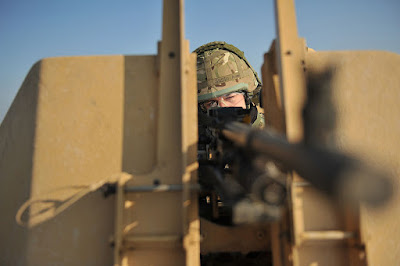 |
| Notice that his left eye is shut (source). |
I don't know how much the issue is actually debated, but I know there are different schools of thought on each topic. For instance, back when pistol sights were generally small and dark and hard to see, the dominant school of thought was "instinctive" shooting, which was not instinctive but required a great deal of practice and relied heavily on placement of the feet and alignment of the body. This was taught to a high degree to FBI and Secret Service agents who, I've read, could make some pretty impressive shots while shooting from the hip. Some of you may even be familiar with Rex Applegate's method of point shooting which, while not shooting from the hip, still uses body and arm alignment to make quick snap shots without using the sights of a pistol. (See the video below).
Somewhat related to the foregoing is the idea that you should shoot with both eyes open. The advantages to shooting with both eyes open has been described thusly:
The increased field of vision is arguably the most important and notable benefit from shooting with both eyes open. Hunters scanning the sky or horizon appreciate being able to spot not just the mallard that’s currently in their scope, but also the one 50 feet away from it for the next shot.
Shooting with both eyes open greatly increases repeatability. This means having both eyes open allows you to move on to the next target quickly without possibly disorienting yourself from making rapid switches between one eye being open and both.
Another article cites a former Green Beret, Karl Erickson, for the following propositions:
When a hectic situation arises, and you need to draw your weapon, you’re going to experience physical and physiological changes.
Most noticeably, the gun operator’s adrenaline will kick up, prompting the “fight or flight” response.
During this response, the body’s sympathetic nervous system releases norepinephrine and adrenaline from the adrenal glands, which are located right above your kidneys, as shown in the picture to the right.
Once these naturally produced chemicals surge through your bloodstream, your heart rate increases and your eyes dilate and widen.
These physical changes occur because the human brain is screaming to collect as much information as possible.
When these events take place, it becomes much more challenging for the shooter to keep their non-dominant eye closed.
Thoughtfully attempting to keep that non-dominant eye shut can potentially derail the shooter’s concentration, which can result in a missed opportunity for a righteous kill shot.
Jon disagrees with keeping both eyes open--at least at the time of the shot--explaining:
Why the shooter has to close the non-aiming eye for the fraction of a second required to release the shot --
Aiming with both eyes open causes the shooter to see a "double image". You can prove this to yourself by sticking your thumb up at arm's length, place it over a distant target, focus on the target and you will see two thumbs, focus on your thumb and you will see two targets.
So, if you are focused on the target and using the wrong front sight image, you will miss the target. If you are focused on the front sight and use the wrong target image, you will miss the target. Murphy's Law guarantees that the shooter will be using the wrong image. [Murphy's Law - Anything that can go wrong, will go wrong, at the worst possible time.]
The shooter won't automatically use the image from the dominant eye, because eye dominance is perceptual, not physiological. So, it can and does change with stress and attention. Eye dominance is not necessarily left or right. It can be 50% - 50%. Or, anything in-between. Everyone is different. Any time a person aims with both eyes open, he will get a double image.
Assuming a hard focus on the front sight, a person using his right eye to aim, who uses the wrong target image will be shooting way off to the left (damaging property, injuring innocent bystanders, maybe killing them). A person using his left eye to aim, who uses the wrong target image will be shooting way off to the right. This is why it is essential to eliminate the double image by closing the non-aiming eye. Murphy's Law says that anything that can go wrong will go wrong, at the worst possible time. So, the person shooting with both eyes open will be shooting at the wrong image, and hitting unintended objects. No such thing as a miss, only unintended hits.
"Anything that can go wrong, will go wrong." So, we must eliminate anything that can go wrong from our weapon system. So, the non-aiming eye must be closed.
I've periodically tried shooting with both eyes open and have to agree with Jon. You can and probably will see a double image of the front sight blade and, at least for me, I have to concentrate in order to mentally shift to focusing one the correct image to use for shooting. I suppose you can train yourself to automatically can do so, but it is not as natural or as easy as simply closing your non-shooting eye when you take the shot.
Besides, when I switch to shooting with my left hand, as I might if my right arm was injured or tied up, I can simply close my right eye and use my left eye to align the sights when I take the shot. I suspect that if you had trained yourself to ignore the non-shooting eye image, it would be difficult to suddenly shift to try and align the sights.
Now, with the addition of micro red dot sights to handguns, this issue may become moot just as it has when shooting a rifle equipped with a red dot.
Some more tips and pointers for cut shells. The host makes clear that cut shells are not intended for use when you have slugs available to y...


